
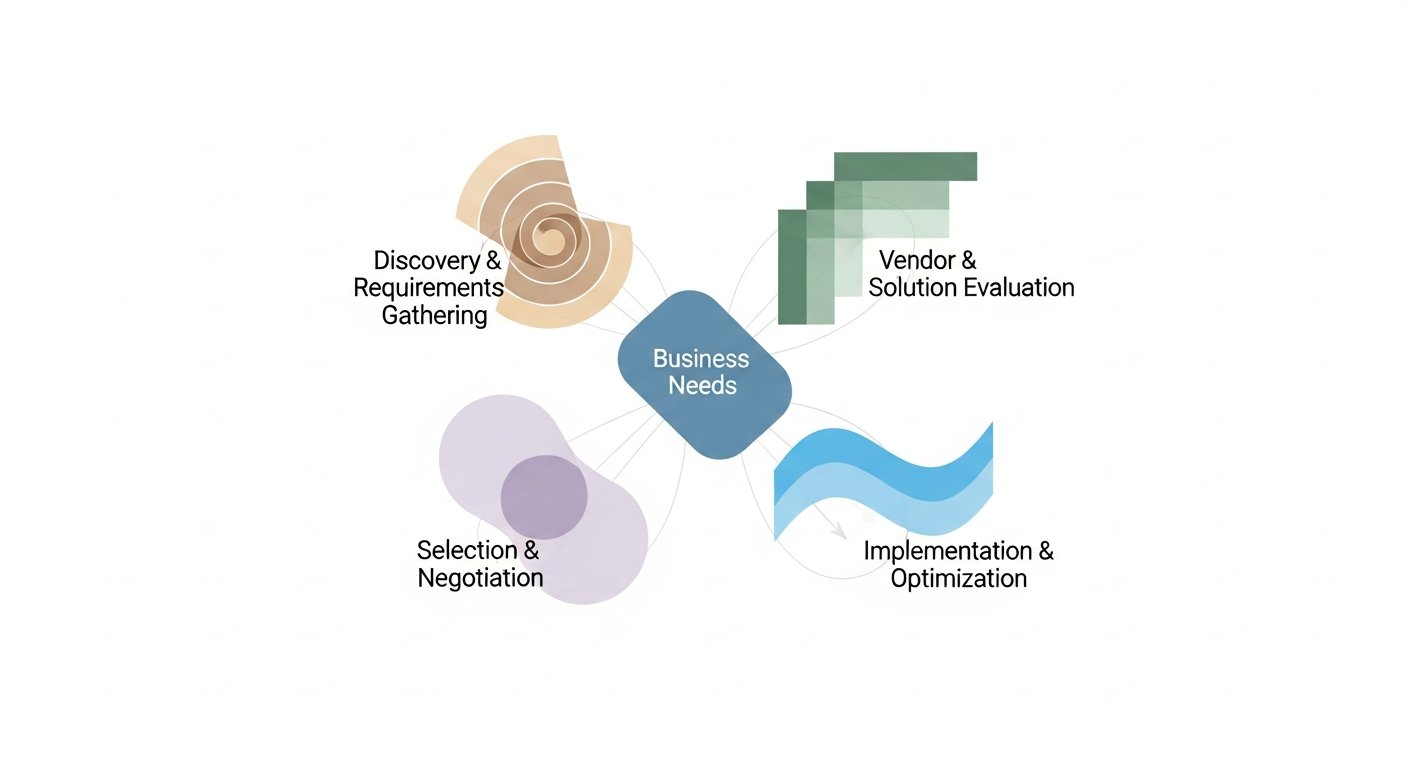
Updated April 2026. Finding the right technology stack does not have to feel like throwing darts in the dark, especially when aggressive growth targets are on the line. A robust Business Software Selection Framework gives organizations a clear, actionable roadmap to pinpoint exactly which tools will drive their digital marketing and expansion strategies forward. Rather than relying on vendor promises or flashy features, a structured approach anchors your procurement process in objective data and operational reality.
Scaling a company introduces massive complexity to internal workflows, customer journey mapping, and lead nurturing. Marketing teams frequently struggle with fragmented data silos when their platforms fail to communicate. By implementing a systematic evaluation methodology, leaders can rapidly filter out incompatible solutions, reducing costly subscription waste and accelerating time-to-value. This ensures that every new application actively contributes to lead generation, customer retention, and overall market share.
The ultimate goal is building a highly integrated ecosystem where data flows seamlessly from first touchpoint to final conversion. A disciplined approach to adopting enterprise technology minimizes the friction of change management, empowering your workforce to focus on high-impact strategic initiatives rather than fighting with misaligned tools.
The Anatomy of a High-Performing Technology Procurement Process
Structuring the Initial Needs Assessment
Organizations waste approximately 35% of their annual technology budgets on underutilized applications (Gartner, 2025). This massive capital drain stems directly from skipping the foundational requirements gathering phase. When marketing leadership bypasses cross-functional input, they often purchase platforms based on aspirational goals rather than daily operational realities. Establishing a baseline of current workflow bottlenecks ensures that the resulting software search solves actual problems rather than introducing new ones. For a deeper dive into requirement gathering, check out our [CLUSTER LINK: software needs assessment guide].
Mapping out your precise functional needs requires interviewing the frontline employees who will interact with the platform daily. A marketing automation specialist managing 50,000 active contacts across six regional segments will identify edge cases and API limitations that an executive sponsor might overlook. Engaging these stakeholders early builds internal consensus and significantly reduces deployment resistance later. When evaluating technological requirements for your company, mapping the daily user journey is mandatory.
Defining Growth-Oriented Parameters
Defining success metrics before contacting vendors establishes an objective grading scale. Teams must create a needs-alignment matrix, a centralized document categorizing desired features as critical, important, or optional based on their direct impact on revenue. If a specific lead-scoring capability directly shortens the sales cycle by three days, it moves to the critical column. Features that merely look appealing in a demo stay in the optional category. Building this matrix prevents scope creep and keeps the evaluation team focused on core business outcomes rather than peripheral functionalities.
How Do You Evaluate Vendor Viability for Marketing Tech?
Filtering the Market Landscape
Navigating the crowded digital marketing technology landscape requires ruthless prioritization. A mid-sized ecommerce brand experiencing rapid catalog expansion realizes their legacy inventory system cannot sync with their dynamic ad campaigns. Orders drop, stockouts plague top-selling items, and customer acquisition costs spike due to bidding on out-of-stock inventory. By issuing a highly specific Request for Information (RFI) targeting real-time sync capabilities, the brand filters 40 potential vendors down to three viable candidates within a week.
Vendor viability extends far beyond feature sets; it encompasses the financial stability, support infrastructure, and product roadmap of the provider. Relying on isolated review sites often paints an incomplete picture. According to a 2026 Forrester market analysis, 62% of B2B software buyers report significant discrepancies between promised integration capabilities and actual post-purchase performance. Thorough vetting requires scrutinizing the vendor’s API documentation, speaking directly with their engineering team, and demanding reference calls with current clients of a similar size and industry.
Connecting Stages to Business Impact
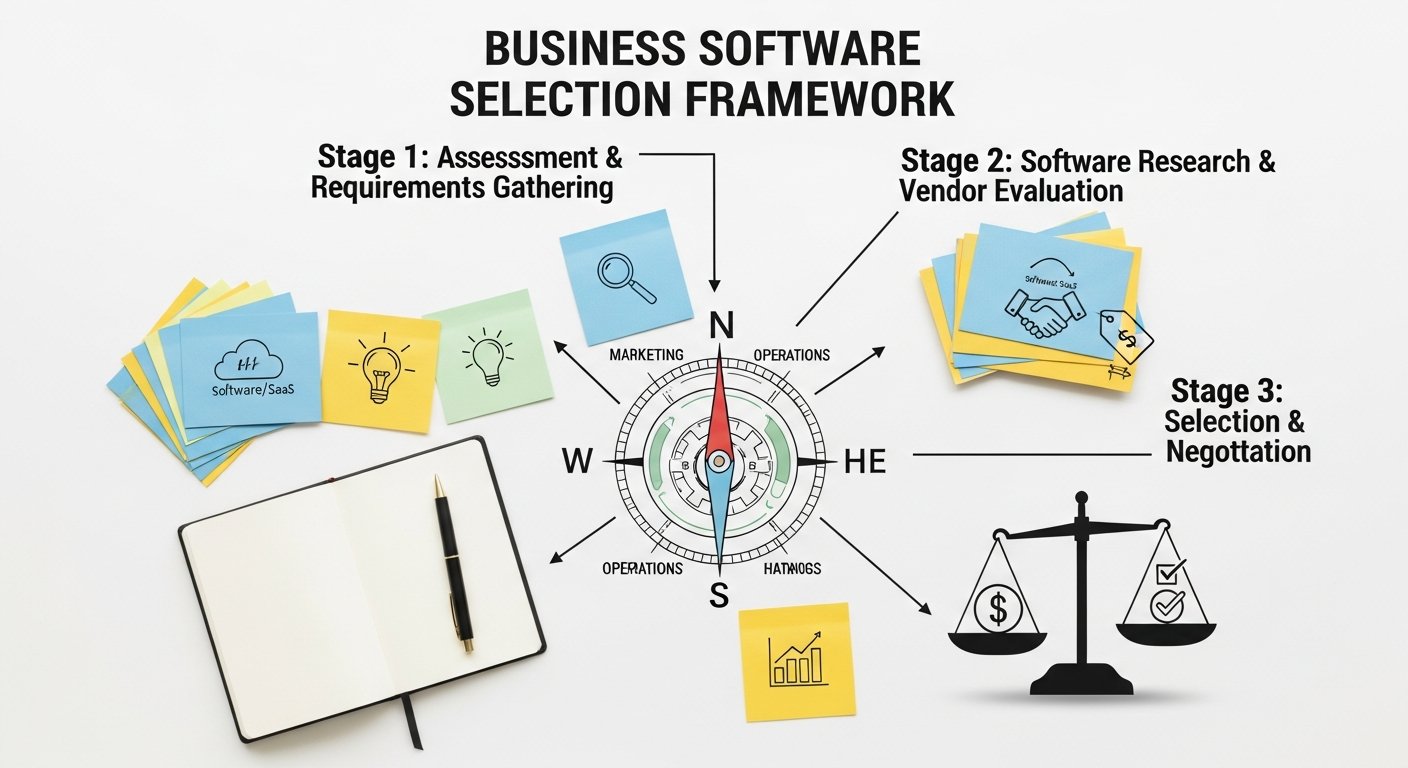
Every step of the procurement journey must tether back to tangible organizational goals. See our [CLUSTER LINK: vendor evaluation criteria] for more detailed metrics. The table below outlines how a structured approach connects each phase to marketing and growth outcomes.
| Framework Stage | Key Activities | Digital Marketing Impact | Example Software Types |
|---|---|---|---|
| Needs Assessment | Stakeholder interviews, workflow mapping | Aligns tool capabilities with lead generation goals | CRM, Marketing Automation |
| Research & Vetting | RFI issuance, API documentation review | Prevents data silos and ensures ecosystem fit | Customer Data Platforms (CDP) |
| Evaluation & Piloting | Sandbox testing, use-case simulation | Guarantees campaign execution speed | SEO & Content Management |
| Implementation | Data migration, user onboarding | Minimizes downtime in active campaigns | Analytics Dashboards |
[INLINE IMAGE 2: A flowchart diagram illustrating the transition from initial vendor research to a shortened evaluation list based on marketing alignment.]
Core Evaluation Criteria for Scalable Architecture
Assessing Integration and Ecosystem Fit
A thoroughly executed Business Software Selection Framework relies heavily on evaluating how a new tool communicates with the existing tech stack. Standalone applications create data friction, requiring manual exports and imports that corrupt contact records and delay campaign launches. When an email marketing platform features native, bi-directional sync with the central CRM, behavioral data triggers hyper-personalized follow-up sequences automatically. This immediate data transfer allows marketing teams to strike while prospect intent is highest, radically improving conversion rates.
System scalability must be tested through aggressive sandbox piloting rather than assumed from marketing collateral. A financial services firm attempting to automate their complex quoting process discovers their chosen tool crashes when handling multi-currency, tiered-discount structures during a live stress test. By identifying this limitation in the pilot phase rather than after a full rollout, they avoid catastrophic sales delays. For businesses dealing with complex pricing logic, utilizing robust configure price quote applications becomes a critical requirement.
Calculating Total Cost of Ownership (TCO)
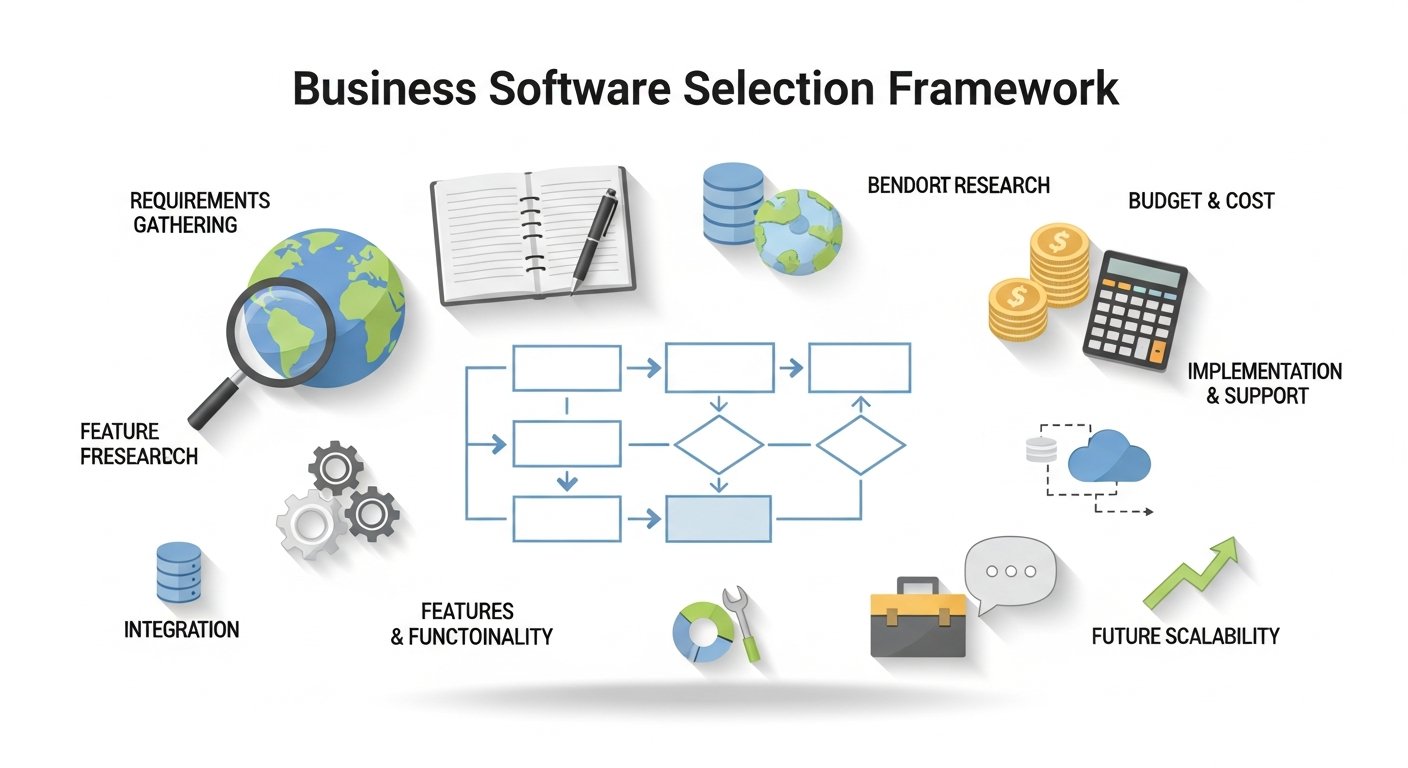
Evaluating the true financial impact of an application involves looking past the initial licensing fees. Implementation consulting, premium support tiers, data migration specialists, and ongoing administration costs frequently double the initial budget within the first year. Companies must establish a clear vendor lock-in threshold—the calculated financial and operational cost of migrating away from the platform if it fails to meet future needs. High lock-in platforms require substantially more rigorous pre-purchase scrutiny. See our [CLUSTER LINK: software ROI calculation] methodology for exact formulas.
SaaS subscription waste is a growing epidemic, with companies averaging $1,200 per employee annually on redundant or unused tools (Zylo, 2025). Aggressively auditing overlapping capabilities during the evaluation stage prevents bloated tech stacks. If a proposed project management suite includes a built-in messaging feature, the evaluation team must decide whether to deprecate their existing chat application or disable the redundant feature in the new tool to avoid fragmenting internal communications.
What Are the True Costs of Implementation and Integration?
Navigating Change Management
What success looks like: A phased rollout where a core group of power users tests the platform for two weeks, documents internal best practices, and then leads peer-to-peer training sessions for the rest of the department. This creates immediate internal champions and drops support tickets by 60% during the first month.
What failure looks like: IT forces a platform switch over a single weekend with only a generic, vendor-provided video tutorial. Marketing campaigns are delayed, data is entered incorrectly due to confusion, and staff revert to using unapproved spreadsheet workarounds to get their jobs done.
The psychological friction of adopting new daily workflows is the highest hidden cost in any technology deployment. Employees develop deep muscle memory for their existing processes, even if those processes are inefficient. Breaking those habits requires dedicated change management resources, clear communication of the personal benefits to the employee, and leadership visibly using the new system. We detail this extensively in our [CLUSTER LINK: software implementation roadmap].
Automating the Deployment Process
Modern integrations rely heavily on middleware and native API connectors rather than custom-coded solutions. Because custom integrations require constant maintenance whenever a vendor updates their code base, relying on standardized connections dramatically lowers long-term IT overhead. When teams focus on automating standard workflows through visual, no-code builders, marketing operations can adjust data flows without waiting weeks in the IT ticketing queue.
Data migration remains the highest-risk phase of implementation. Transferring historical customer interactions, active subscription statuses, and behavioral tags requires meticulous data cleansing before the transfer begins. Migrating dirty data simply moves existing problems into a more expensive database. Companies that invest in a comprehensive data audit prior to implementation report a 45% faster time-to-value for their new marketing platforms (HubSpot, 2026).
[INLINE IMAGE 4: A bar chart comparing upfront licensing fees versus long-term integration and change management costs over a five-year period.]
Continuous Optimization and Post-Deployment Review
Establishing Feedback Loops
Deployment marks the beginning of the technology lifecycle, not the end. Treating a software launch as a finished project guarantees that the platform will gradually fall out of alignment with evolving digital marketing strategies. Regularly scheduled quarterly reviews ensure that the tool’s usage matures alongside the team’s capabilities. During these reviews, administrators analyze feature adoption rates to identify areas where staff need additional training or where the software interface itself is creating user friction. Read more in our [CLUSTER LINK: post-deployment software optimization] guide.
Capturing frontline feedback is vital for continuous improvement. When marketing coordinators document workarounds or missing features in centralized information repositories, IT and operations teams gain actionable intelligence. This documentation forms the basis for negotiating feature requests with the vendor or adjusting internal processes. If 80% of a team is ignoring a specific module, the company must either retrain the staff on its value or downgrade their subscription tier to stop paying for unused capacity.
Monitoring Health Metrics
System health monitoring extends beyond uptime statistics. It involves tracking how quickly data moves between systems, monitoring error rates in automated marketing triggers, and measuring the time it takes users to complete core tasks. A drop in task completion speed often indicates that a recent platform update has complicated the workflow. By actively monitoring these metrics, companies can proactively address issues before they impact customer-facing campaigns or lead to broad employee frustration.
Vendor relationship management is a continuous activity. Holding semi-annual strategic alignment meetings with your vendor account manager ensures your company is prepared for upcoming product changes. These meetings provide an opportunity to review the vendor’s roadmap, secure early access to beta features that could offer a competitive edge, and negotiate pricing based on expanding user counts or data storage needs.
Types of Common Pitfalls in Digital Tool Adoption
Recognizing Systemic Failures
Even with substantial budgets, digital marketing deployments frequently fail due to predictable, avoidable errors in the procurement phase. When organizations skip rigorous methodology, they invite structural vulnerabilities into their revenue operations. Understanding these pitfalls allows procurement teams to build defensive strategies into their selection criteria. Explore our [CLUSTER LINK: business software mistakes] hub for comprehensive case studies.
Many leadership teams fall victim to the “shiny object syndrome,” prioritizing cutting-edge AI features over basic stability and integration capabilities. A marketing department purchases an advanced predictive analytics engine, only to realize their foundational CRM data is too fragmented and inaccurate for the AI to process correctly. The expensive new tool sits idle because the company failed to assess their internal data readiness before purchasing.
Critical Errors to Avoid
- Ignoring End-User Input: Purchasing platforms based solely on executive demonstrations guarantees low adoption rates. Frontline workers will reject tools that add administrative overhead without making their specific daily tasks easier.
- Underestimating Migration Complexity: Failing to allocate sufficient time and budget for data cleansing and structural mapping leads to corrupted customer records and stalled campaign launches.
- Neglecting Change Management: Software does not solve behavioral problems. Without dedicated training programs and clear expectations, employees will revert to old habits and legacy systems.
- Siloed Purchasing Decisions: When marketing buys a tool without consulting sales or IT, they create data silos. This prevents the organization from monitoring performance metrics visually across the entire customer journey.
Failing to define clear, measurable success metrics prior to implementation makes it impossible to calculate a true return on investment. If a company cannot quantify the hours saved or the revenue generated by a new platform, they cannot justify the ongoing subscription costs during budget reviews.
How Is Artificial Intelligence Reshaping Tool Selection?
The Impact of Predictive Capabilities
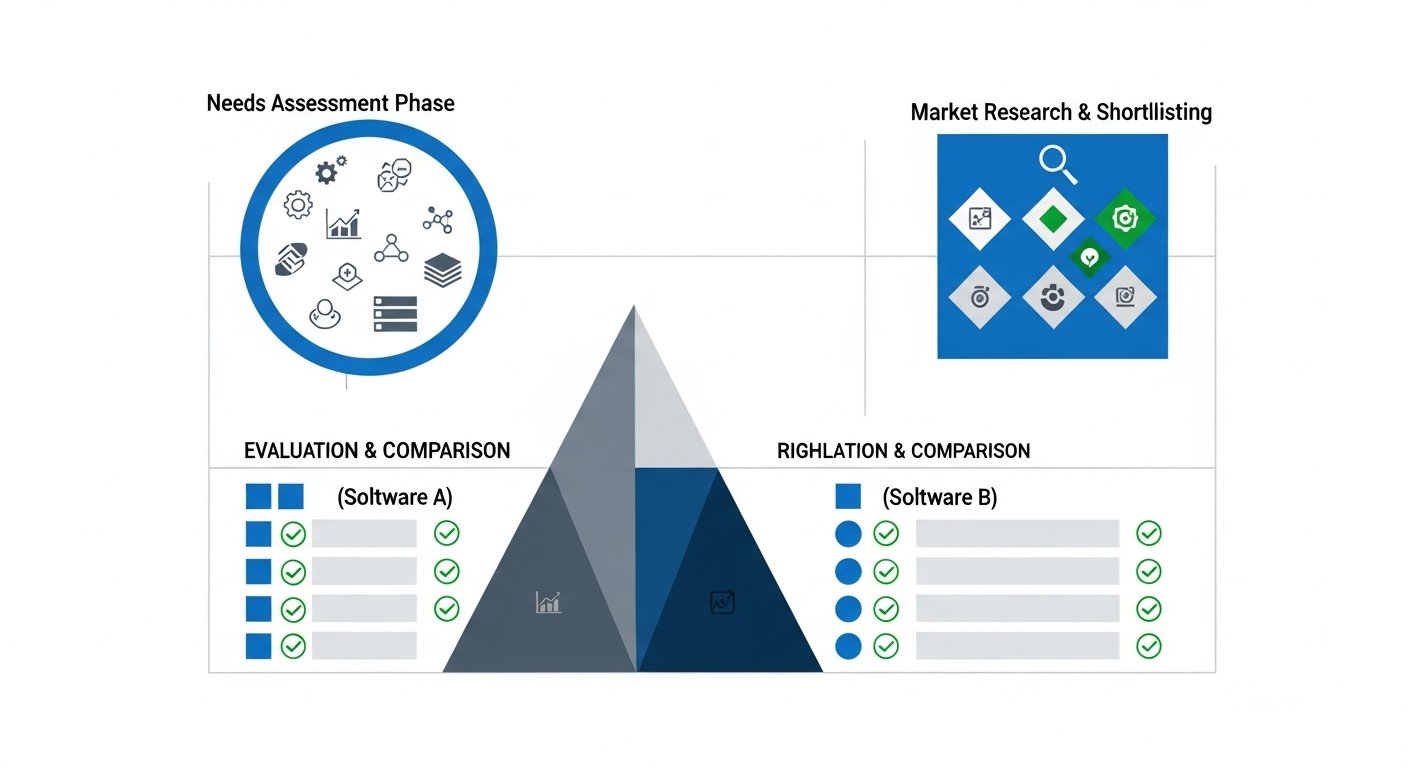
The integration of machine learning into enterprise applications has fundamentally altered how organizations evaluate technology. Modern platforms are no longer static repositories of information; they are active participants in strategy execution. When assessing a new marketing suite, procurement teams now must evaluate the transparency, accuracy, and training models of the vendor’s underlying algorithms. A tool that automatically segments audiences based on real-time behavioral shifts provides a massive competitive advantage over legacy platforms requiring manual rule creation. For more on this evolution, visit our [CLUSTER LINK: AI in business software] overview.
AI-driven natural language processing (NLP) has democratized access to complex data analysis. A marketing manager asks their analytics platform, “Which content piece generated the highest quality leads last quarter?” and receives an instant, formatted report. This conversational capability eliminates the need for advanced SQL knowledge, allowing non-technical staff to make rapid, data-backed decisions. Consequently, the user interface and NLP capabilities of a tool have become primary grading criteria during the evaluation phase.
Future-Proofing Your Technology Stack
Evaluating vendor roadmaps for future AI integrations is no longer optional. The pace of technological advancement means that a platform lacking a clear strategy for generative AI and automated workflow optimization will become obsolete within two years. Companies must ask vendors how they plan to incorporate large language models into their native environment without compromising proprietary company data or violating evolving privacy regulations.
Ultimately, wrapping these advanced considerations into your Business Software Selection Framework ensures your marketing stack remains agile and secure. By systematically demanding proof of AI utility rather than settling for marketing hype, organizations can build a technology infrastructure that actively accelerates growth rather than merely supporting it.
Sources & References
- Gartner. (2025). The State of Enterprise Software Procurement and Utilization. Gartner Research.
- Forrester. (2026). B2B Technology Buying Trends: Closing the Integration Gap. Forrester Wave Reports.
- Zylo. (2025). Annual SaaS Management Index: The Cost of Redundancy. Zylo Institute.
- HubSpot. (2026). The State of Marketing Operations and Data Migration ROI. HubSpot Data Insights.
- McKinsey & Company. (2026). Maximizing Technology ROI Through Strategic Alignment. Digital Practice Insights.