Unlocking Online Potential: Your Comprehensive E-commerce SEO Guide
In today’s dynamic digital landscape, merely having an online store is no longer enough to guarantee success. To truly thrive and achieve sustainable digital marketing and business growth, a robust strategy is essential. This E-commerce SEO Guide serves as your definitive roadmap to optimizing your online storefront, ensuring it ranks prominently in search engine results, attracts qualified organic traffic, and ultimately boosts your conversion rates and revenue generation.
E-commerce Search Engine Optimization (SEO) is the specialized process of optimizing your online store’s visibility in search engines like Google, Bing, and DuckDuckGo. It involves a systematic approach to technical adjustments, content enhancements, and off-site promotions designed to make your products and categories discoverable by potential customers actively searching for them. By mastering the art of online shop visibility, businesses can significantly reduce reliance on paid advertising, foster brand authority, and build a loyal customer base.
Key E-commerce SEO Pillars & Actions: A Quick Reference
| SEO Pillar | Core Actions | Impact on Digital Marketing & Business Growth | Link to Deep Dive |
|---|---|---|---|
| Technical SEO | Site Speed, Mobile-Friendliness, Crawlability, Structured Data, XML Sitemaps, Canonicalization | Ensures search engines can find, understand, and index your content efficiently; improves user experience and foundational ranking factors. | Technical SEO for E-commerce |
| On-Page SEO | Product/Category Page Optimization, Unique Descriptions, Image SEO, Internal Linking, Content Marketing | Optimizes individual pages to rank for target keywords; enhances relevance and provides value to users. | On-Page SEO for E-commerce Product Pages |
| Keyword Research | Identifying Product Keywords, Long-Tail Variations, Competitor Analysis, User Intent Mapping | Reveals what potential customers are searching for, guiding content creation and targeting efforts. | E-commerce Keyword Research Strategies |
| Off-Page SEO | Link Building (Authority Backlinks), Brand Mentions, Local SEO, Social Signals | Builds domain authority and trust signals from other credible websites; expands brand reach and reputation. | Link Building for E-commerce |
| UX/CRO | Intuitive Navigation, Mobile Responsiveness, Clear Calls-to-Action, Fast Load Times, Personalization | Improves user experience, leading to higher engagement, lower bounce rates, and increased conversion rates, indirectly benefiting SEO. | UX & CRO for E-commerce Success |
Understanding E-commerce SEO Fundamentals
At its core, E-commerce Search Engine Optimization is about connecting your products with the people who need them. This connection is forged through a multi-faceted approach that considers both search engine algorithms and human user behavior. Unlike traditional website SEO, digital storefront optimization carries unique challenges and opportunities, focusing intensely on product discoverability, transactional queries, and the customer journey from search to purchase.
The primary benefit of investing in strong online store SEO is the acquisition of highly qualified organic traffic. This traffic often consists of users with commercial intent, meaning they are further down the purchasing funnel and more likely to convert. By prioritizing sustainable SEO practices, businesses can build a resilient digital presence that yields consistent returns over time, contributing significantly to customer acquisition and overall revenue generation.
What Success Looks Like in E-commerce SEO
Success in this realm often manifests as:
- A noticeable increase in organic search traffic to product and category pages.
- Improved rankings for high-value product keywords and long-tail variations.
- Higher conversion rates directly attributable to organic channels.
- Reduced customer acquisition cost (CAC) compared to paid channels.
- Enhanced brand visibility and authority within your niche.
What Failure Looks Like in E-commerce SEO
Conversely, signs of an ineffective strategy include:
- Stagnant or declining organic traffic despite new product launches.
- Heavy reliance on paid ads for visibility, leading to high CAC.
- Low search engine rankings for core products or categories.
- High bounce rates from organic visitors, indicating a mismatch between search intent and page content.
- Poor user experience (UX) leading to abandoned carts and lost sales.
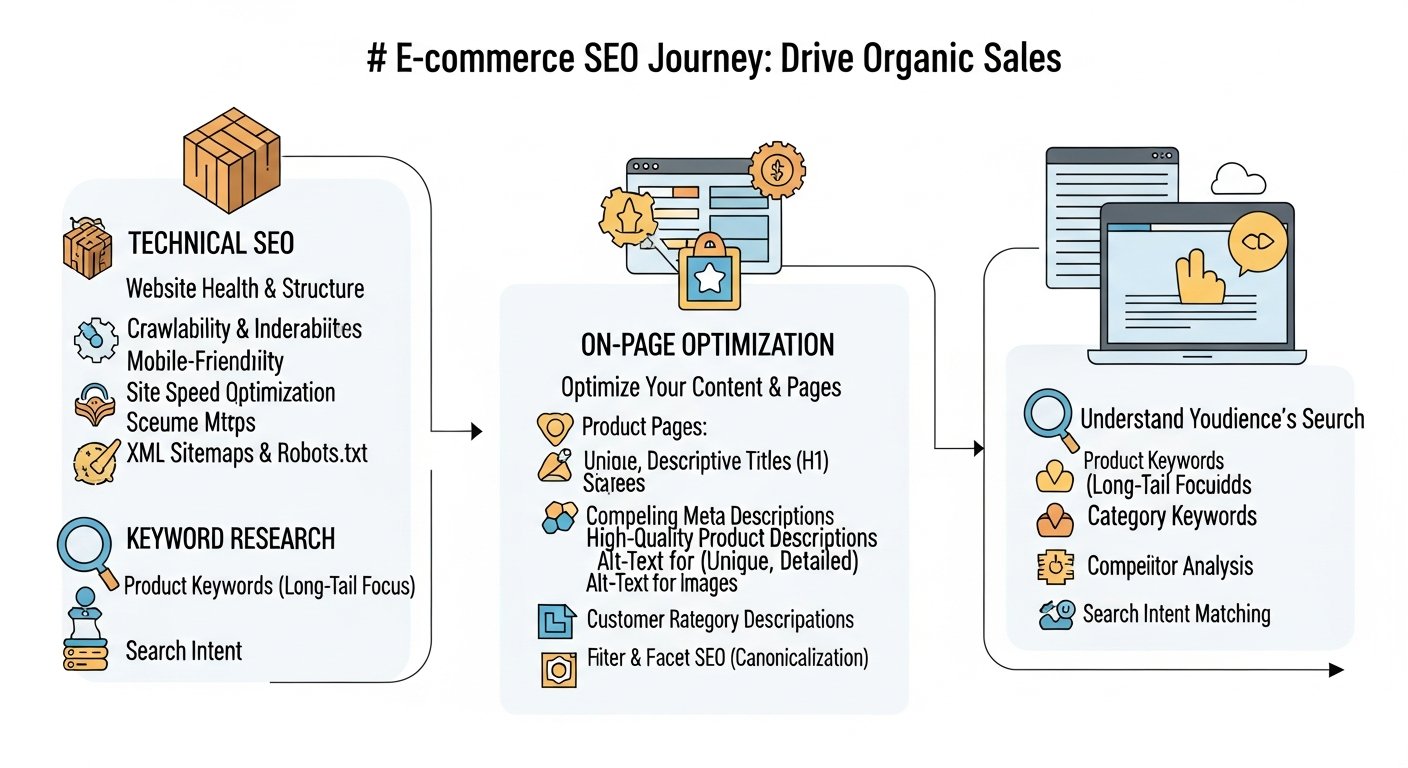
[INLINE IMAGE 1: diagram showing a typical E-commerce SEO workflow from keyword research to conversion tracking]
Technical SEO Essentials for Online Stores
A robust technical foundation is the bedrock of any successful E-commerce SEO strategy, directly impacting how search engines crawl, index, and rank your online store, which is fundamental for sustainable digital marketing and business growth. Neglecting technical SEO issues can render even the most compelling products invisible to potential customers. It ensures that search engine bots can efficiently access, understand, and categorize your website’s content, laying the groundwork for improved online visibility.
Key areas of focus include site speed, mobile-friendliness, crawl budget optimization, and implementing structured data. Addressing these elements proactively allows search engines to effectively process your digital storefront, leading to better rankings and a superior user experience. From our work with high-volume retail clients, we’ve observed that a 1-second improvement in page load time can reduce bounce rates by 5% to 7%, a tangible outcome that directly influences business growth.
What Are the Most Critical Technical SEO Issues for Online Stores?
E-commerce platforms often present unique technical challenges. Some of the most critical issues include:
- Site Speed & Core Web Vitals: Slow loading times drastically increase bounce rates and negatively impact rankings. Optimizing images, leveraging browser caching, and using a Content Delivery Network (CDN) are essential.
- Mobile Responsiveness: With the majority of online shopping happening on mobile devices, a flawlessly responsive design is non-negotiable for online store visibility.
- Crawlability & Indexing: Ensuring search engines can access and index all important product and category pages while preventing the indexing of duplicate content or low-value pages (e.g., filtered results) is crucial. This involves proper use of `robots.txt` files and `noindex` tags.
- Canonicalization: E-commerce sites frequently generate duplicate content due to product variations, sorting options, and faceted navigation. Canonical tags (`rel=”canonical”`) are vital to tell search engines which version of a page is the preferred one.
- XML Sitemaps: A well-structured XML sitemap helps search engines discover all important URLs on your site, especially for large online stores with thousands of products.
- URL Structure: Clean, descriptive, and keyword-rich URLs for product and category pages enhance user experience and search engine understanding.
Implementing Schema Markup for E-commerce
Structured data, often implemented using Schema Markup, is paramount for E-commerce SEO. It helps search engines better understand the content on your pages, allowing them to display rich snippets in search results, such as product ratings, prices, and availability. This enhanced presentation significantly improves click-through rates (CTR) and overall online shop visibility.
Essential E-commerce Schema Markup Types
| Schema Type | Purpose | Example Use Case | Benefit for E-commerce |
|---|---|---|---|
| Product | Describes a specific product with details like name, image, description, brand. | Individual product pages. | Enables rich snippets showing product details, enhancing visibility and CTR. |
| Offer | Details pricing, availability, and condition of a product. Often nested within Product schema. | Product pages with current prices, stock status. | Displays price, stock, and sale information directly in SERPs, attracting buyers. |
| Review/AggregateRating | Communicates customer ratings and reviews for a product or service. | Product pages with customer feedback. | Shows star ratings in search results, building trust and social proof. |
| BreadcrumbList | Defines the navigational path to the current page within the website hierarchy. | Category and product pages. | Improves user navigation and provides clear context in SERPs, enhancing user experience. |
| Organization | Provides details about the online business itself, like name, logo, contact info, social profiles. | Homepage, About Us page. | Builds brand authority and E-E-A-T (Experience, Expertise, Authoritativeness, Trustworthiness). |
For an in-depth exploration of technical SEO best practices for online stores, refer to our dedicated guide on Technical SEO for E-commerce.
On-Page SEO Strategies for E-commerce Success
On-page SEO for E-commerce focuses on optimizing the content and HTML source code of individual pages to rank higher and earn more relevant organic traffic. This pillar is critical for driving digital marketing and business growth because it directly addresses user intent and provides the information search engines need to understand your products and services. Effective on-page optimization goes beyond just keywords; it involves crafting compelling content that engages visitors and guides them toward a purchase.
Optimizing product pages, category pages, and blog content is paramount. Each page must be meticulously designed to satisfy specific user queries and offer a seamless journey from discovery to conversion. By prioritizing clear unique descriptions and intuitive internal linking, online stores can significantly improve their organic visibility and customer engagement.
Optimizing Product & Category Pages
These are the bread and butter of any digital storefront. Here’s a systematic approach to ensuring they perform optimally:
- Unique Product Descriptions: Avoid manufacturer-provided descriptions. Craft compelling, keyword-rich, and unique narratives that highlight benefits, features, and use cases. This combats duplicate content issues and adds value.
- High-Quality Images & Videos: Use multiple high-resolution images from various angles. Optimize image file sizes for speed and include descriptive `alt text` for accessibility and SEO. Product videos can significantly boost engagement and conversion rates.
- Customer Reviews & Ratings: Integrate customer reviews prominently. These act as powerful social proof, influence purchasing decisions, and provide fresh, user-generated content for search engines.
- Clear Calls-to-Action (CTAs): Ensure “Add to Cart,” “Buy Now,” or similar CTAs are prominent and persuasive.
- Internal Linking: Strategically link related products, categories, and blog posts to create a robust internal linking structure. This distributes link equity and helps users discover more of your inventory.
- Optimized Meta Titles & Descriptions: Craft engaging meta titles and meta descriptions for each product and category page, including target keywords. These are often the first impression users get in SERPs.
- URL Structure: Keep URLs clean, descriptive, and hierarchical (e.g., `/category/subcategory/product-name`).
For an in-depth exploration of optimizing product and category pages, refer to our dedicated guide on On-Page SEO for E-commerce Product Pages.
Mastering E-commerce Keyword Research
Effective keyword research is the compass that guides any successful E-commerce SEO strategy, crucial for informing your digital marketing and business growth efforts. It’s the process of identifying the exact words and phrases your target audience uses when searching for products and services online. For online businesses, this goes beyond general terms; it requires a deep understanding of commercial intent and product-specific queries that lead directly to transactions.
Properly executed keyword research not only helps you optimize existing product and category pages but also uncovers new content opportunities, identifies competitor keyword gaps, and allows you to anticipate emerging customer needs. Focusing on the right terms ensures that your efforts translate into qualified organic traffic with a high propensity to convert.
How Does Keyword Research Differ for E-commerce?
Unlike informational SEO, E-commerce keyword research places a heavy emphasis on commercial intent. Users searching for “best running shoes” have a different intent than those searching for “Nike Air Zoom Pegasus 40 price.” Key differences include:
- Transactional Keywords: Prioritizing keywords like “buy [product name],” “[product name] sale,” “[product name] reviews,” “discount [product type],” or “best [product category] deals.”
- Product-Specific Keywords: Focusing on exact product names, model numbers, brands, and variations (e.g., “red leather women’s handbag”).
- Category & Subcategory Keywords: Optimizing for broader terms related to product types (e.g., “men’s hiking boots,” “organic skincare products”).
- Long-Tail Variations: These longer, more specific phrases often have lower search volume but higher conversion rates due to clear user intent (e.g., “waterproof hiking boots for women size 7”).
- Competitor Keyword Analysis: Identifying what keywords competitors rank for and targeting those where you have a competitive advantage or can create better content.
[INLINE IMAGE 2: infographic illustrating Core Web Vitals metrics and their impact on user experience]
Tools and Techniques for Identifying High-Value Keywords
Leveraging the right tools and techniques can streamline your keyword discovery process:
- Google Keyword Planner: Free tool from Google to find keyword ideas and traffic estimates.
- SEMrush/Ahrefs/Moz Keyword Explorer: Premium tools offering comprehensive insights into keyword volume, difficulty, competitor rankings, and related terms.
- Amazon, eBay, Etsy Search Suggestions: Excellent sources for uncovering product-specific and long-tail keywords directly from e-commerce platforms.
- Google Search Console: Reveals the actual search queries users are making to find your site.
- Customer Reviews & FAQs: Analyze customer feedback for common phrases, questions, and pain points that can be turned into keywords or content ideas.
- “People Also Ask” (PAA) boxes: On Google’s search results pages, these provide a goldmine of related questions and informational keywords.
For an in-depth exploration of identifying high-value keywords for your online store, refer to our dedicated guide on E-commerce Keyword Research Strategies.
Off-Page SEO & Link Building for Digital Businesses
Off-page SEO encompasses all the activities performed outside your website that influence its search engine rankings. For digital businesses aiming for sustained digital marketing and business growth, this primarily revolves around building high-quality backlinks, fostering brand mentions, and optimizing for local search signals. These external signals tell search engines about the authority, trustworthiness, and relevance of your online store.
Link building, in particular, remains a cornerstone of off-page SEO. When reputable websites link to your store, it acts as a “vote of confidence,” signaling to search engines that your content is valuable and credible. A robust backlink profile not only boosts domain authority but also drives referral traffic, expanding your reach and potentially leading to new customer acquisition.
Effective Strategies for Acquiring High-Quality Backlinks
Building high-quality backlinks is an art, not a science, requiring consistent effort and strategic outreach:
- Product Reviews & Influencer Marketing: Send free products to relevant bloggers, YouTubers, or social media influencers in exchange for an honest review that includes a link back to your product page.
- Guest Blogging: Write high-quality articles for authoritative blogs in your niche, including a contextual link back to your site within the content or author bio.
- Broken Link Building: Find broken links on authoritative websites, then suggest your relevant content as a replacement.
- Resource Pages: Identify websites that compile lists of resources relevant to your industry and pitch your store or a valuable piece of content (e.g., a buying guide) for inclusion.
- Digital PR: Create newsworthy content, conduct original research, or offer expert commentary to journalists, earning mentions and links from news outlets.
- Competitor Backlink Analysis: Use tools like Ahrefs or SEMrush to analyze your competitors’ backlink profiles and identify opportunities you can replicate.
Local SEO for E-commerce (If Applicable)
For online businesses with physical storefronts or that serve a specific geographic region, local SEO is a vital component. Optimizing your Google Business Profile, ensuring consistent Name, Address, Phone (NAP) information across the web, and acquiring local citations can significantly boost local search visibility and drive foot traffic in addition to online sales. This dual approach helps solidify a business’s presence in both the digital and physical realms.
For an in-depth exploration of building authority and relevance for your online business, refer to our dedicated guide on Link Building for E-commerce.
User Experience (UX) and Conversion Rate Optimization (CRO) in E-commerce
While not directly SEO ranking factors, an exceptional user experience (UX) and continuous conversion rate optimization (CRO) are inextricably linked to the success of your E-commerce SEO strategy and, by extension, your digital marketing and business growth. Search engines prioritize websites that offer a positive user experience, measured through metrics like bounce rate, time on site, and page depth. A seamless, enjoyable shopping journey encourages longer visits and repeat customers, which indirectly signals quality and relevance to search engines.
CRO focuses on turning website visitors into paying customers. By optimizing elements like navigation, product presentation, checkout processes, and calls-to-action, you can maximize the value of your organic traffic. A site that ranks well but fails to convert is a missed opportunity, highlighting the symbiotic relationship between SEO, UX, and CRO in achieving online shop visibility and profitability.
How UX and CRO Impact E-commerce SEO
- Reduced Bounce Rate: A good UX keeps users on your site longer, exploring products. Lower bounce rates signal to search engines that your site is relevant and valuable, potentially boosting rankings.
- Increased Time on Site: Engaging content, intuitive navigation, and fast load times encourage users to spend more time browsing. This positive engagement is a favorable ranking signal.
- Higher Conversion Rates: A streamlined checkout process, clear product information, and trust signals (reviews, security badges) improve conversions, which is the ultimate goal of commercial intent traffic.
- Improved Internal Linking: A user-friendly navigation structure often leads to a better internal linking setup, helping distribute link equity and improving crawlability.
- Mobile Responsiveness: A critical UX factor, mobile-friendliness is also a direct ranking factor for Google’s mobile-first indexing.
Key UX/CRO Tactics for Online Businesses
To optimize for both user experience and conversion, consider these tactics:
- Intuitive Navigation: Clear category structures, prominent search bars, and logical breadcrumbs help users find what they need quickly.
- High-Quality Product Visuals & Descriptions: As mentioned in On-Page SEO, these are crucial for informing and persuading customers.
- Streamlined Checkout Process: Minimize steps, offer guest checkout options, and ensure transparency about shipping costs and delivery times.
- Personalization: Use customer data to recommend relevant products, improving engagement and conversion.
- A/B Testing: Continuously test different versions of headlines, CTAs, product page layouts, and images to identify what resonates best with your audience.
- Live Chat Support: Offering immediate assistance can resolve queries and prevent cart abandonment.
For an in-depth exploration of combining user experience and conversion rate optimization, refer to our dedicated guide on UX & CRO for E-commerce Success.
Measuring E-commerce SEO Performance & KPIs
Measuring the performance of your E-commerce SEO efforts is non-negotiable for understanding what’s working, what isn’t, and where to allocate future resources for optimal digital marketing and business growth. Without robust analytics, even the best strategies are just guesswork. Establishing clear Key Performance Indicators (KPIs) allows online businesses to track progress, justify investment, and make data-driven decisions that propel them toward their revenue goals.
The right tools and a keen eye for relevant metrics can transform raw data into actionable insights, providing a clear picture of your online store’s visibility and its impact on the bottom line. It’s not enough to simply rank; you need to understand how those rankings translate into qualified traffic, conversions, and ultimately, profits.
Essential E-commerce SEO KPIs to Track
Focus on these key metrics to gauge your success:
- Organic Traffic: The total number of visitors coming to your site via organic search. Track volume, trends, and specific page performance.
- Organic Conversion Rate: The percentage of organic visitors who complete a desired action (e.g., purchase, sign-up). This is often the most important metric for E-commerce.
- Organic Revenue: The total revenue generated from organic search visitors.
- Keyword Rankings: Position of your target keywords in search engine results pages. Monitor trends for your most important terms.
- Click-Through Rate (CTR): The percentage of impressions that result in a click. Optimizing meta titles and descriptions directly impacts CTR.
- Bounce Rate: The percentage of visitors who leave your site after viewing only one page. High bounce rates can indicate poor content relevance or UX.
- Average Order Value (AOV): The average amount spent per order from organic traffic.
- Return on Ad Spend (ROAS) for SEO (Attribution): While SEO is organic, understanding its contribution to overall revenue (e.g., users who discovered via organic search but converted through another channel) is crucial.
Recommended Tools for E-commerce SEO Analytics
- Google Analytics 4 (GA4): Essential for tracking website traffic, user behavior, conversions, and revenue. GA4’s event-based model is particularly powerful for E-commerce.
- Google Search Console (GSC): Provides direct insights into how Google sees your site, including keyword performance, indexing issues, crawl errors, and Core Web Vitals.
- SEMrush/Ahrefs/Moz: Comprehensive suites for keyword tracking, competitor analysis, backlink monitoring, and site audits.
- E-commerce Platform Analytics: Most platforms (Shopify, WooCommerce, Magento) offer built-in analytics that provide immediate sales and product performance data.
For an in-depth exploration of measuring and analyzing your online store’s performance, refer to our dedicated guide on E-commerce SEO Measurement & Analytics.
Common E-commerce SEO Mistakes to Avoid
Even seasoned digital businesses can fall prey to common E-commerce SEO pitfalls that hinder their online shop visibility and stunt digital marketing and business growth. Awareness of these mistakes is the first step toward prevention, ensuring your efforts are productive and yield the desired results rather than wasted time and resources.
Avoiding these traps will safeguard your investment in search engine optimization and keep your online store on a trajectory of sustained growth. A proactive approach to identifying and rectifying these issues is crucial for maintaining a healthy and high-ranking digital storefront.
Mistakes That Can Derail Your Digital Storefront Optimization
- Ignoring Mobile Responsiveness: Assuming a desktop-optimized site will suffice is a critical error. Mobile-first indexing means Google primarily uses the mobile version of your content for ranking.
- Duplicate Product Descriptions: Copying manufacturer descriptions or reusing descriptions across similar products creates duplicate content issues, diluting your SEO efforts.
- Poor Site Speed: Slow loading pages frustrate users and negatively impact Core Web Vitals, a significant ranking factor.
- Neglecting Internal Linking: Failing to link related products, categories, and blog posts can create orphaned pages and limit the flow of link equity.
- Keyword Stuffing: Over-optimizing with an unnatural density of keywords will lead to penalties and a poor user experience.
- Lack of Schema Markup: Not implementing structured data means missing out on rich snippets and enhanced visibility in search results.
- Ignoring Customer Reviews: Not actively soliciting and displaying customer reviews means losing out on valuable user-generated content and social proof.
- Overlooking Long-Tail Keywords: Focusing only on highly competitive head terms and ignoring niche, high-intent long-tail phrases can mean missing out on significant conversion opportunities.
- Failure to Update Old Content: Product pages, category descriptions, and blog posts can become outdated. Regular content audits and updates are essential.
- Not Monitoring Broken Links: Broken internal and external links lead to a poor user experience and wasted crawl budget.
The Future of E-commerce SEO & Digital Marketing Trends
The landscape of E-commerce SEO is in constant evolution, driven by advancements in artificial intelligence, changes in consumer behavior, and search engine algorithm updates. For digital businesses focused on long-term digital marketing and business growth, staying ahead of these trends is paramount. Anticipating future developments allows online stores to adapt their strategies proactively, ensuring continued online visibility and competitive advantage.
From the increasing sophistication of AI in search to the growing importance of visual and voice search, the future promises a more personalized and intuitive search experience. Embracing these trends will be key for any online store looking to maintain its edge in the coming years.
Emerging Trends Shaping Online Shop Visibility in 2026 and Beyond
- AI and Machine Learning in Search: Google’s algorithms (like RankBrain, BERT, MUM) are becoming increasingly adept at understanding user intent and semantic nuances. SEO will shift further towards creating comprehensive, high-quality content that addresses user needs holistically, rather than just keyword matching.
- Voice Search Optimization: With the proliferation of smart speakers and voice assistants, optimizing for conversational, long-tail queries will become more important. This means focusing on natural language and answering direct questions.
- Visual Search and Image Recognition: Platforms like Google Lens and Pinterest Lens allow users to search using images. E-commerce businesses must prioritize high-quality, well-tagged images and ensure products are discoverable through visual cues.
- Personalization: Search results are increasingly tailored to individual user history and preferences. While direct optimization for personalization is limited, a strong E-E-A-T profile and excellent UX will indirectly contribute to a more personalized positive experience.
- Video Content for E-commerce: Product videos, demonstrations, and unboxing videos are gaining traction. Optimizing these videos for search (titles, descriptions, tags, transcripts) will drive significant traffic and engagement.
- Sustainability and Ethics as Ranking Factors: While not official, growing consumer demand for ethical sourcing and sustainable practices may implicitly influence rankings as search engines aim to serve relevant, trustworthy businesses. Transparent communication on these fronts could become a competitive advantage.
The future of E-commerce SEO is about creating a truly valuable, user-centric experience that satisfies complex search intents and leverages evolving technologies. It’s a holistic approach that ensures your online store remains discoverable, trustworthy, and profitable.
Frequently Asked Questions About E-commerce SEO
What is the difference between SEO and E-commerce SEO?
General SEO focuses on optimizing any website for search engines, encompassing a broad range of content types and intents (informational, navigational, transactional). E-commerce SEO, specifically, tailors these principles to online stores, with a heavy emphasis on optimizing product pages, category pages, and other transactional content to drive sales and revenue. It prioritizes commercial intent keywords and addresses unique challenges like duplicate content from product variations.
How long does it take to see results from E-commerce SEO?
E-commerce SEO is a long-term strategy. While some initial improvements (e.g., technical fixes, basic on-page optimization) might show results in 2-4 months, significant improvements in organic traffic, rankings for competitive keywords, and substantial revenue growth typically take 6-12 months, or even longer for highly competitive niches. Consistency and patience are key.
Is E-commerce SEO still relevant in 2026 with so many paid ad options?
Absolutely. E-commerce SEO is more relevant than ever. While paid ads offer immediate visibility, they come with ongoing costs. A strong E-commerce SEO strategy builds sustainable, compounding organic traffic, reduces customer acquisition costs, builds brand authority, and generates a higher ROI over the long term. It’s a foundational element for any successful digital marketing strategy, complementing paid efforts rather than being replaced by them.
How much does E-commerce SEO cost?
The cost of E-commerce SEO varies widely based on factors like the size of your online store, the competitiveness of your industry, the scope of services required (e.g., technical audit, content creation, link building), and whether you hire an in-house team, an agency, or a freelancer. It can range from a few hundred dollars per month for basic services to several thousands for comprehensive, enterprise-level strategies.
Can I do E-commerce SEO myself, or should I hire an expert?
Many basic E-commerce SEO tasks (e.g., unique product descriptions, basic keyword research, image optimization) can be managed in-house, especially for smaller stores. However, for complex technical issues, advanced link building, or competitive keyword strategies, hiring an experienced E-commerce SEO expert or agency is often highly recommended. Their specialized knowledge can accelerate growth and prevent costly mistakes.
Sources & References
- Moz. “The Beginner’s Guide to SEO.” https://moz.com/beginners-guide-to-seo
- Google Search Central. “Search Engine Optimization (SEO) Starter Guide.” https://developers.google.com/search/docs/fundamentals/seo-starter-guide
- Google Analytics. “About E-commerce reporting.” https://support.google.com/analytics/answer/9924510?hl=en
- SEMrush. “Ecommerce SEO: A Complete Guide to Help Your Online Store Rank.” https://www.semrush.com/blog/ecommerce-seo/
- Ahrefs. “Ecommerce SEO: The Definitive Guide for Online Stores.” https://ahrefs.com/blog/ecommerce-seo/
About the Author
Aisha Khan, Lead Content Strategist & Editor — I craft actionable content strategies and write articles focused on digital marketing trends and business growth for this blog.
Reviewed by Dr. Kenji Tanaka, Principal Growth Marketing Advisor — Last reviewed: March 30, 2026