
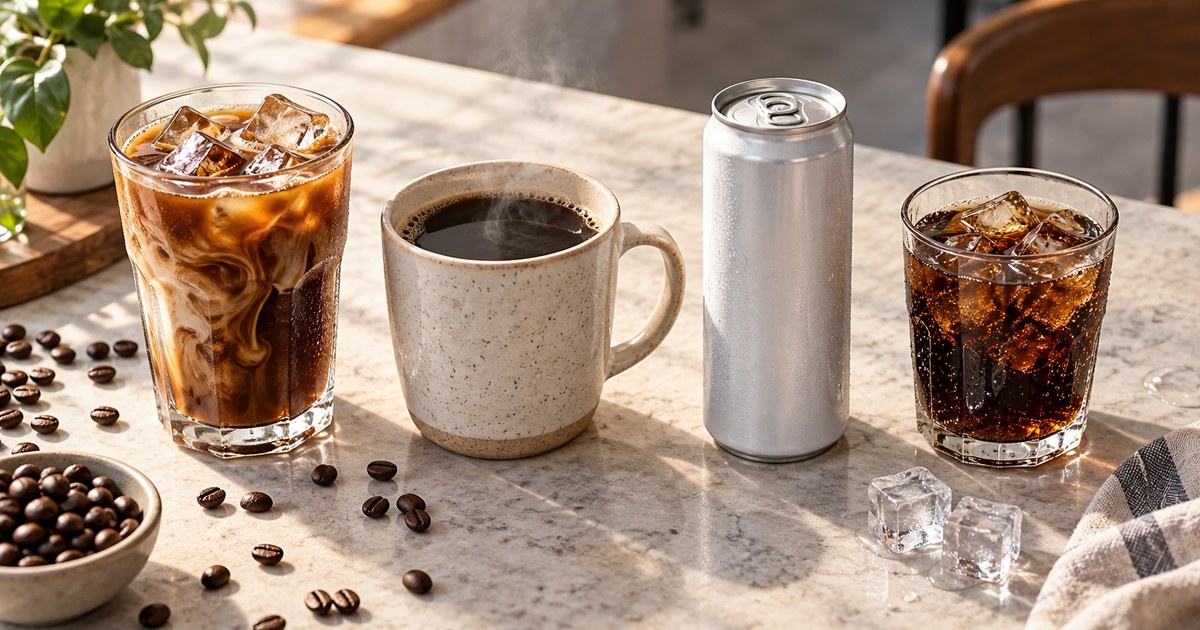
Most drink menus will tell you the flavor, the size and the price. A lot of them will not tell you the one number that decides how your next four hours go. Caffeine is the active ingredient in an enormous share of what gets sold as a refreshment, and it is also the ingredient most often left off the board. That is worth fixing, because the spread between two drinks sitting side by side under the same heading can be larger than most people would guess.
"Energy Drink" Is Not a Measurement
The phrase describes a marketing category, not a dose. Two cups labeled the same way can differ enormously, and nothing on the outside of either one tells you which is which. That matters in both directions. Someone who is sensitive to caffeine, pregnant, on medication that interacts with it, or simply trying to sleep before a morning shift is making a real decision with no information. And someone deliberately buying caffeine before training has no way to know whether they got a useful amount or a token one. The fix is not to avoid the category. It is to buy from places that print the number.
Two Things Ride Along With the Caffeine
Dose is the headline, but two other variables change the experience just as much. The first is the source. Caffeine from tea and caffeine added as an isolated ingredient are chemically the same molecule, but they usually arrive in very different company: different volume, different accompanying ingredients, and often a different rate at which people report feeling it. If a menu tells you where the caffeine came from, that is a menu that has thought about the question.
The second is sugar. Flavor problems are frequently solved with sugar, and a drink built to taste good and deliver a large caffeine dose has a strong pull in that direction. Two drinks with identical caffeine content can differ enormously in what else they bring. Checking sugar alongside caffeine is a two-second habit that changes what you end up buying.
What a Menu That Prints the Numbers Looks Like
It is rarer than it should be, and it is not confined to large chains. Fuel Up Energy Cafe, a family-owned shop in Bolingbrook, Illinois, prints caffeine by size directly on the board: its green-tea-based drinks carry 160mg in a 24-ounce cup and 240mg in a 32-ounce, with less than a gram of sugar in every flavor. Calorie counts sit next to them. Whether those particular numbers suit you is beside the point. The part worth copying is that you can compare before you order rather than after.
A posted number also tells you something about the operation: a shop that publishes caffeine per size is a shop that portions consistently, because otherwise the number would be a lie. If your usual spot does not print it, ask. Staff generally know, and a menu that cannot answer the question is telling you something too.
How Much Is Actually in the Cup
The reason the number matters is the range hiding behind one word. A typical brewed coffee runs somewhere between 95 and 200 milligrams in an eight-ounce cup, depending on the beans and the brew. A shot of espresso is often less than that, around 60 to 75 milligrams, because the serving is tiny even though it tastes stronger. A can of cola sits near 30 to 40. Tea varies wildly, from under 30 in a light brew to well over 70 in a strong one.
Energy drinks are where the label stops being optional. Cans in the same cooler can hold anywhere from 80 milligrams to more than 300, and the tall cans that look like one serving are sometimes labeled as two. That is the whole argument for a printed number: the category name tells you nothing, and the container size can mislead you on purpose.
The FDA's guidance on caffeine puts 400 milligrams a day as an amount not generally associated with negative effects for healthy adults, and notes that people who are pregnant, trying to become pregnant, or breastfeeding should talk with their doctor about a lower limit. Four hundred milligrams is roughly four small coffees, or it can be a single oversized can plus a morning cup. Without the number on the board, you cannot tell which day you are having.
The Caffeine-Free Side Is Usually Bigger Than It Looks
Here is the part that surprises people. At a lot of drink-forward shops, the majority of the menu has no caffeine in it at all. The caffeinated items get the branding, the bright colors and the counter placement, so they read as the whole board when they are often a minority of it. That is genuinely useful if you are cutting back, ordering for a kid, or buying a second drink at four in the afternoon. Ask which items are caffeine-free rather than assuming there are one or two. The honest answer is frequently most of them.
The Short Version
Caffeine is the most consequential number on a drink menu and the one least likely to be printed. Ask for it by size, check what sugar is riding along with it, and remember that the caffeine-free half of the board is usually larger than the marketing suggests. Three questions, ten seconds, and you actually know what you bought.
Putting the Number to Use
Knowing the dose only helps if you do something with it. A practical habit is to set a personal ceiling and count toward it. For most healthy adults the figure cited by regulators is 400 milligrams a day, and plenty of people feel worse well below that: jittery, unable to sleep, or flat in the afternoon after a large morning dose. Your own number is the one that matters, and you can only find it by paying attention for a couple of weeks.
Timing matters as much as total. Caffeine has a half-life of roughly five hours, so a 200 milligram drink at 3pm still leaves about 100 milligrams in your system at 8pm and 50 at 1am. People who sleep badly and blame stress are often simply dosing too late. A cutoff six to eight hours before bed fixes more sleep problems than any change to the mattress.
Watch the stacking. Coffee with breakfast, a tea mid-morning, a pre-workout drink and a cola with lunch is four separate decisions that nobody adds up. Writing them down for three days is usually enough to show where the total actually comes from, and it is almost always a different drink than the one you suspected.
Special Cases Worth Knowing
Pregnancy changes the arithmetic. Caffeine crosses the placenta, and health authorities advise pregnant people to keep intake substantially lower than the general adult guidance, commonly under 200 milligrams a day. That is one strong coffee, or it is two modest teas. Someone who drank freely before pregnancy needs the actual numbers on the menu far more than the average customer does, which is another argument for shops printing them.
Children are the other group menus ignore. Soft drinks, sweet teas and chocolate drinks carry caffeine that adds up across a day, and the same dose that is trivial for an adult is proportionally large for a child. Asking which items are caffeine-free, rather than assuming a fruit-flavored drink qualifies, is a reasonable habit for anyone ordering for kids.
Medications interact too. Some antibiotics, thyroid medications and heart drugs change how the body clears caffeine, so a usual amount suddenly feels like far more. Anyone who starts a new prescription and finds their regular coffee suddenly unbearable should raise it with the prescriber rather than puzzling over the coffee.
Making the Shop Answer
If your regular shop does not post caffeine content, asking once usually fixes it. Staff who pull the shots know roughly what is in them, and a manager who hears the question repeatedly will add it to the board because it is cheaper than answering all day. Phrase it as a request for the number by size, not as a complaint. The shops that refuse or shrug are telling you they do not measure, which means the dose varies with whoever is working.
Chain menus are ahead of independents here, mostly because consistency across thousands of stores forces them to standardize. Use that. If a chain publishes its caffeine table online, you can learn what a normal range looks like for drinks of a given size and then judge the independent shop against it. A 20-ounce coffee claiming 50 milligrams is implausible. One claiming 400 for a single cup deserves skepticism of a different kind.
Keep the goal modest. You are not trying to eliminate caffeine. You are trying to know the number so the decision is yours instead of the menu's. Once you know it, the rest is preference, and preference is the easy part.