
The Executive Edge: Top Mobile Productivity Apps for Leaders in 2026
In the high-stakes world of corporate leadership and business ownership, time is not just money—it is the ultimate strategic resource. As we move into 2026, the traditional boundaries of the office have dissolved entirely, replaced by a “leadership-anywhere” philosophy. Today’s executive is just as likely to approve a multi-million dollar merger from a smartphone in an airport lounge as they are from a boardroom. However, the sheer volume of digital noise can easily lead to “app fatigue” if your toolkit isn’t curated for high-level decision-making.
For the modern professional, a mobile productivity stack must do more than just organize a to-do list; it must provide clarity, facilitate seamless delegation, and offer real-time insights into organizational health. The right software transforms your mobile device from a source of distraction into a command center. This guide explores the essential mobile productivity apps that are defining executive workflows in 2026, focusing on tools that prioritize security, AI-driven efficiency, and strategic alignment.
1. AI-Powered Personal Assistants: Reclaiming Your Calendar
The single greatest challenge for any executive is the “calendar creep”—the slow accumulation of low-priority meetings that swallow up deep-work time. In 2026, the most effective leaders have moved beyond traditional virtual assistants toward AI-first scheduling and time-management platforms like **Motion** and **Reclaim.ai**.
These apps use sophisticated algorithms to act as a digital chief of staff. Unlike static calendars, these tools analyze your priorities and automatically reshuffle your schedule when a high-priority “fire” breaks out. For an executive, this means you no longer have to manually move five meetings because a client call ran long. The mobile interface of these apps provides a “Daily Brief” that highlights not just where you need to be, but what you need to achieve.
Furthermore, predictive scheduling tools now integrate with your biometric data via wearables. If your focus levels are typically highest between 9:00 AM and 11:00 AM, the app will auto-block that time for strategic thinking, pushing administrative tasks to your afternoon slump. This level of personalized optimization is no longer a luxury; it is a prerequisite for maintaining a competitive edge in a hyper-fast business environment.
2. Strategic Communication and Unified Messaging
Communication is the lifeblood of leadership, but for many business owners, it has become a source of friction. Executives are often buried under a mountain of Slack pings, Microsoft Teams notifications, and WhatsApp messages. To regain control, professionals are turning to unified communication hubs like **Beeper** or specialized executive email clients like **Superhuman**.
Superhuman’s mobile experience is specifically designed for speed. It allows executives to fly through hundreds of emails with intuitive gestures, AI-generated summaries, and “remind me” features that ensure no strategic follow-up falls through the cracks. In 2026, the app’s AI can even draft responses based on your historical tone and previous decisions, allowing you to give “direction” rather than just “dictation.”
For internal team communication, the focus has shifted toward asynchronous video and voice. Tools like **Loom** and **Otter.ai** are essential for the executive on the move. Instead of calling a 30-minute meeting, a leader can record a 2-minute video brief while walking between terminals. Otter’s mobile app serves as a real-time transcription and summary tool for every meeting you attend, ensuring that “action items” are automatically captured and synced with your project management software without you having to take a single note.
3. High-Level Project Oversight and KPI Tracking
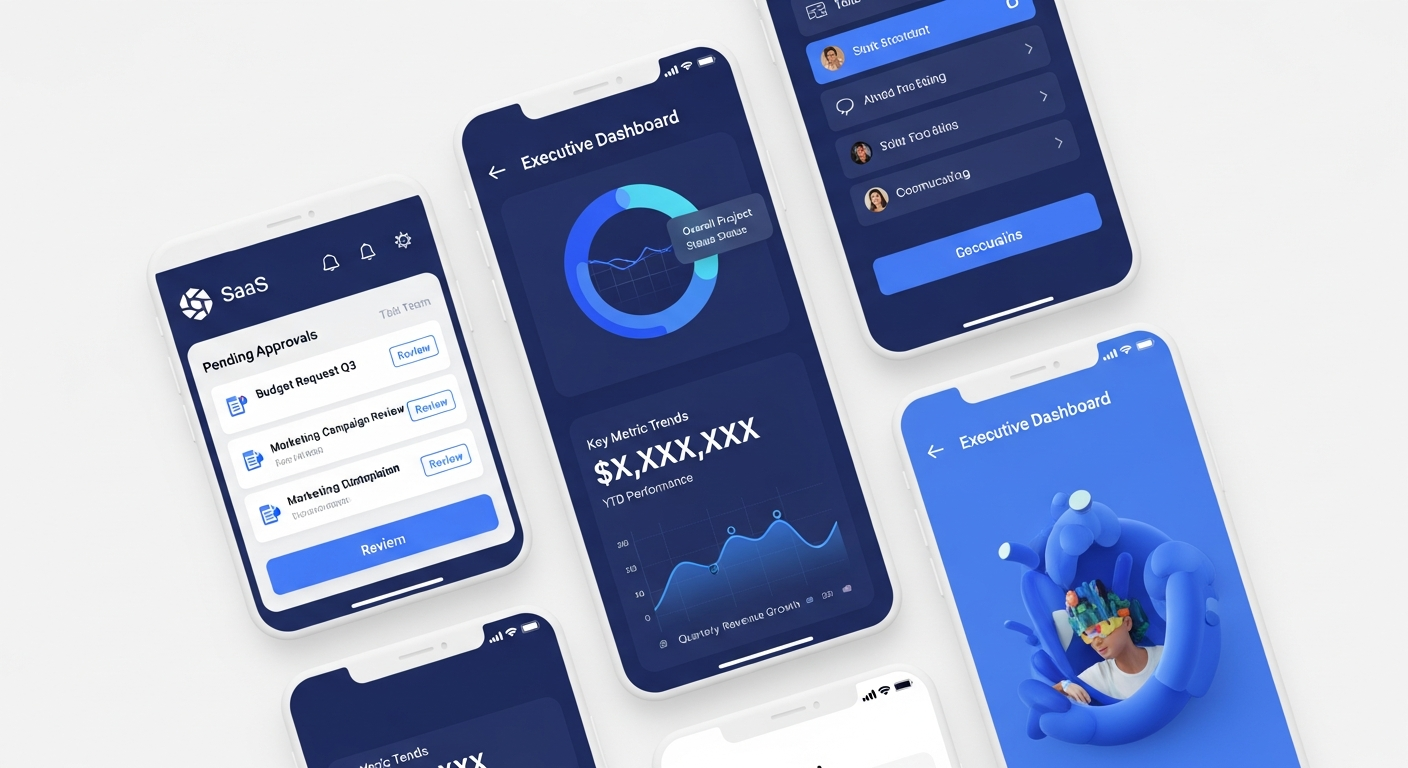
Executives should not be managing individual tasks; they should be monitoring outcomes. However, staying connected to the “pulse” of the company is vital. Mobile-first project management tools like **Monday.com** and **Asana** have evolved their 2026 iterations to offer “Executive Dashboards.”
These dashboards strip away the granular details of sub-tasks and instead present high-level “health scores” for various departments. Are the Q3 goals on track? Is the product launch delayed? A quick glance at your mobile device provides a visual representation of progress against KPIs (Key Performance Indicators).
The integration of Power BI and Tableau mobile apps also allows business owners to carry their company’s data in their pocket. In 2026, these apps feature natural language processing (NLP). You can literally ask your phone, “What was our net profit margin in the EMEA region last week compared to forecast?” and receive an instant, visualized answer. This accessibility to data empowers executives to make evidence-based decisions during lunch meetings or transit, rather than waiting for a monthly report from the analytics team.
4. The “Second Brain”: Knowledge Management for Leaders
The most successful leaders are perpetual learners who constantly consume information, from market trends to competitive intelligence. The challenge lies in capturing and retrieving this information. Knowledge management apps, often referred to as a “Second Brain,” have become indispensable for the 2026 executive.
**Notion** and **Obsidian** lead this category. For a business owner, Notion acts as a centralized repository for company SOPs, strategic visions, and personal notes. Its mobile app has been significantly optimized for quick capture, allowing you to dictate a thought or snap a photo of a whiteboard and have it automatically categorized into your broader strategy.
**Obsidian**, on the other hand, is favored by executives who prioritize privacy and networked thought. It allows you to see the connections between different ideas—linking a book you read on leadership to a specific challenge you’re facing with your sales team. Having this repository on your mobile device means that during any downtime, you can review your strategic notes, ensuring that your long-term vision remains at the forefront of your daily actions.
5. Security, Privacy, and Document Execution
As an executive, your mobile device is a high-value target for cyber threats. Security is the foundation upon which all other productivity is built. In 2026, professionals are moving away from standard consumer-grade security toward enterprise-level protection on their mobile devices.
Apps like **Signal** for encrypted communication and **NordPass Business** for robust password management are non-negotiable. Furthermore, the need for physical signatures has virtually vanished. **DocuSign** and **Adobe Acrobat Sign** are essential for the executive who needs to authorize contracts and legal documents instantly.
In 2026, these document apps utilize advanced biometric verification and blockchain-based audit trails to ensure the highest level of security and legal compliance. Whether it’s an NDA, a new hire contract, or a partnership agreement, the ability to securely review and execute documents on a smartphone ensures that the pace of business is never hindered by administrative bottlenecks.
6. Wellness and Cognitive Performance Apps
Peak executive performance is impossible without physical and mental well-being. The 2026 executive recognizes that productivity is a byproduct of energy management, not just time management. Consequently, wellness apps have moved from the “lifestyle” folder to the “business” folder.
**Oura** and **Whoop** have become staples in the C-suite. Their mobile apps provide “Readiness Scores” that tell an executive when they are primed for high-pressure negotiations and when they should prioritize recovery. If your recovery score is low, the AI assistant (linked to your calendar) might suggest moving a grueling board meeting to the following day.
Additionally, apps like **Headspace for Work** or **Calm** are utilized by professionals to practice “micro-meditations” between high-stress calls. Maintaining emotional regulation and cognitive clarity is a competitive advantage; these mobile tools provide the prompts and techniques to ensure that an executive’s mind remains as sharp as their strategy.
—
#
FAQ: Mobile Productivity for Executives
**Q1: How do I avoid “app overload” when building my executive toolkit?**
The key is integration. Choose a “core” ecosystem (like Microsoft 365 or Google Workspace) and ensure all other apps you add can “talk” to that core. Use a maximum of 5–7 primary apps. If an app doesn’t solve a recurring pain point or save you at least 30 minutes a week, it’s likely just digital clutter.
**Q2: Are mobile AI assistants secure enough for sensitive corporate data?**
In 2026, “Enterprise AI” is the standard. Look for apps that offer “Zero-Knowledge” encryption and comply with global standards like GDPR or CCPA. Many executive-level apps now offer private cloud instances where your data is never used to train public AI models.
**Q3: Can these apps really replace a human Personal Assistant (PA)?**
They don’t replace a PA; they augment them. A human assistant focuses on high-level nuances, relationship management, and complex problem-solving, while the apps handle the rote logistics of scheduling, transcription, and data visualization. This allows your human staff to provide higher-value strategic support.
**Q4: What is the best way to transition my team to these new tools?**
Lead by example. When you start sending Loom videos instead of long emails, or using shared Notion pages for strategy, your team will naturally follow. Additionally, ensure you provide training sessions so that the “productivity” tools don’t become a source of frustration for those less tech-savvy.
**Q5: Is it worth paying for “Pro” or “Enterprise” versions of these apps?**
Absolutely. For an executive, the cost of a premium subscription is negligible compared to the value of your time. Enterprise versions typically offer enhanced security, better integration capabilities, and priority support, which are essential for business continuity.
—
Conclusion: The Future of Frictionless Leadership
As we navigate the complexities of 2026, the distinction between “working” and “leading” becomes clearer. Leadership is about vision, culture, and high-stakes decision-making. The mobile productivity apps highlighted in this guide are designed to strip away the “work”—the administrative friction, the scheduling conflicts, and the data silos—allowing the executive to focus on the “leading.”
By leveraging AI-driven scheduling, unified communication, and mobile-first data analytics, business owners can maintain a level of agility that was previously impossible. However, the most important “app” remains the executive’s own judgment. These digital tools are merely force multipliers. When used correctly, they don’t just make you faster; they make you better, providing the clarity and time necessary to steer your organization toward its long-term goals in an ever-evolving global marketplace. Your smartphone is no longer a phone; it is your most powerful strategic asset. Use it wisely.
For more on bookmark sharing tools that help professionals curate and revisit high-value resources, see bookmarksharer.com.