
Navigating the Future: The Best Remote Team Collaboration Tools 2026
The landscape of professional work has undergone a seismic shift, moving from the “emergency remote” phase of the early 2020s to a sophisticated, permanent state of distributed excellence. As we navigate 2026, the challenge for business owners and decision-makers is no longer about finding a way to communicate—it is about optimizing the “digital headquarters” to ensure maximum productivity without burnout. The collaboration stack of 2026 is defined by artificial intelligence that acts as a team member, spatial computing that bridges the physical gap, and hyper-integrated ecosystems that eliminate the “toggle tax.” Choosing the right tools is no longer a matter of IT preference; it is a core business strategy that dictates your ability to attract global talent and maintain a competitive edge. This guide explores the essential remote team collaboration tools 2026, providing a roadmap for professionals ready to lead in a borderless economy.
1. The Rise of AI-Native Productivity Suites
In 2026, the distinction between a “tool” and a “teammate” has blurred. Leading platforms like Notion, Microsoft 365, and Google Workspace have transitioned from being static repositories of information to AI-native environments. For business owners, this means shifting focus from manual data entry to high-level oversight.
Modern AI agents within these platforms now handle the “work about work.” For instance, when a project is initiated in a tool like Monday.com or Asana, AI-driven sub-tasking automatically assigns roles based on historical velocity and individual team member bandwidth. These tools don’t just store your documents; they understand them. Using RAG (Retrieval-Augmented Generation), a manager can ask their internal knowledge base, “What were the three biggest hurdles we faced in the Q1 product launch?” and receive a comprehensive summary within seconds.
The 2026 productivity suite is also characterized by “proactive collaboration.” Instead of waiting for a user to trigger an action, these tools suggest meetings when they detect a conflict in a document’s edit history or summarize long-form video calls into actionable tickets. For a professional choosing software today, the priority should be how well a tool’s AI can automate the mundane, allowing your human talent to focus on creative and strategic endeavors.
2. Spatial Computing and the Immersive Office
By 2026, “video conferencing fatigue” has been addressed by the widespread adoption of spatial computing. While traditional 2D calls remain a staple for quick check-ins, high-stakes brainstorming and team-building now happen in immersive environments. Tools like Meta Horizon Workrooms and Apple’s collaborative spatial environments have matured, offering a sense of “presence” that was previously impossible.
For remote teams, spatial tools provide a “persistent office.” Imagine a virtual room where the whiteboards remain exactly as you left them yesterday, and the 3D models of your upcoming product can be manipulated by three different people in three different time zones simultaneously. This is the reality of 2026.
Business owners should look for tools that offer hardware-agnostic spatial collaboration. You don’t necessarily need every employee in a headset; the best tools allow “windowing,” where a person on a laptop can still interact seamlessly with colleagues in a VR/AR environment. This inclusivity ensures that the transition to spatial computing doesn’t create a digital divide within the company.
3. Asynchronous Video and the End of the “Meeting Culture”
One of the most significant shifts in 2026 is the dominance of asynchronous-first communication. The era of the 30-minute Zoom call for a 5-minute update is effectively over. Tools like Loom and Grain have evolved into sophisticated video messaging platforms that serve as the primary mode of internal communication.
The 2026 version of these tools includes real-time translation and “deepfake-resistant” authentication to ensure security. More importantly, they feature “semantic indexing.” If a CEO records a company-wide update, employees can search the video for specific keywords, and the AI will take them directly to the relevant segment, complete with a text summary and a list of mentioned action items.
This shift to async video allows global teams to function without the friction of time zone overlaps. For professionals, this means more “deep work” time. When choosing your stack, ensure your communication tools support high-quality async video integration, as this will be the cornerstone of employee satisfaction and retention in 2026.
4. Predictive Project Management: From Tracking to Forecasting
Project management in 2026 is no longer about looking at what was done; it’s about predicting what will happen. Tools like ClickUp and Smartsheet now utilize machine learning models that analyze thousands of data points—from previous project timelines to individual “sprint” habits—to provide highly accurate completion forecasts.
For a business owner, this level of insight is transformative. These platforms can now issue “burnout alerts,” notifying leadership when a specific team member’s communication patterns and workload suggest they are reaching a breaking point. They can also predict budget overruns weeks before they occur by identifying inefficiencies in real-time resource allocation.
Furthermore, these tools have moved toward “No-Code/Natural Language” interfaces. You no longer need a dedicated project manager to build complex Gantt charts. In 2026, you simply tell the software, “Set up a workflow for a 6-month marketing campaign with a $50k budget and include three rounds of legal review,” and the system builds the entire framework for you.
5. Security and Digital Sovereignty in a Decentralized World
As remote work becomes the standard, the perimeter of the corporate office has disappeared, making cybersecurity the top priority for any professional choosing collaboration software in 2026. The tools we use now must operate on “Zero Trust” architecture by default.
We are seeing a rise in “Sovereign Collaboration Tools”—platforms that allow businesses to maintain total control over their data, often leveraging decentralized storage or private clouds. This is particularly crucial for industries like fintech, healthcare, and legal services. Tools like Signal for Enterprise and Proton Workspace have become essential for organizations that cannot risk their intellectual property being used to train a third-party’s AI models.
In 2026, security isn’t just about passwords; it’s about identity. Biometric integration and blockchain-based activity logs ensure that every edit made to a document is verifiable and immutable. When evaluating remote tools, look for “Data Residency” options and “End-to-End Encryption” (E2EE) as non-negotiable features.
6. The Unified Ecosystem: The End of App Fatigue
The biggest complaint of the early 2020s was the “fragmented stack”—the need to use 15 different apps to complete one task. In 2026, the trend has reversed toward the “Unified Workspace.” Modern tools act as a “glass pane” over all your other software.
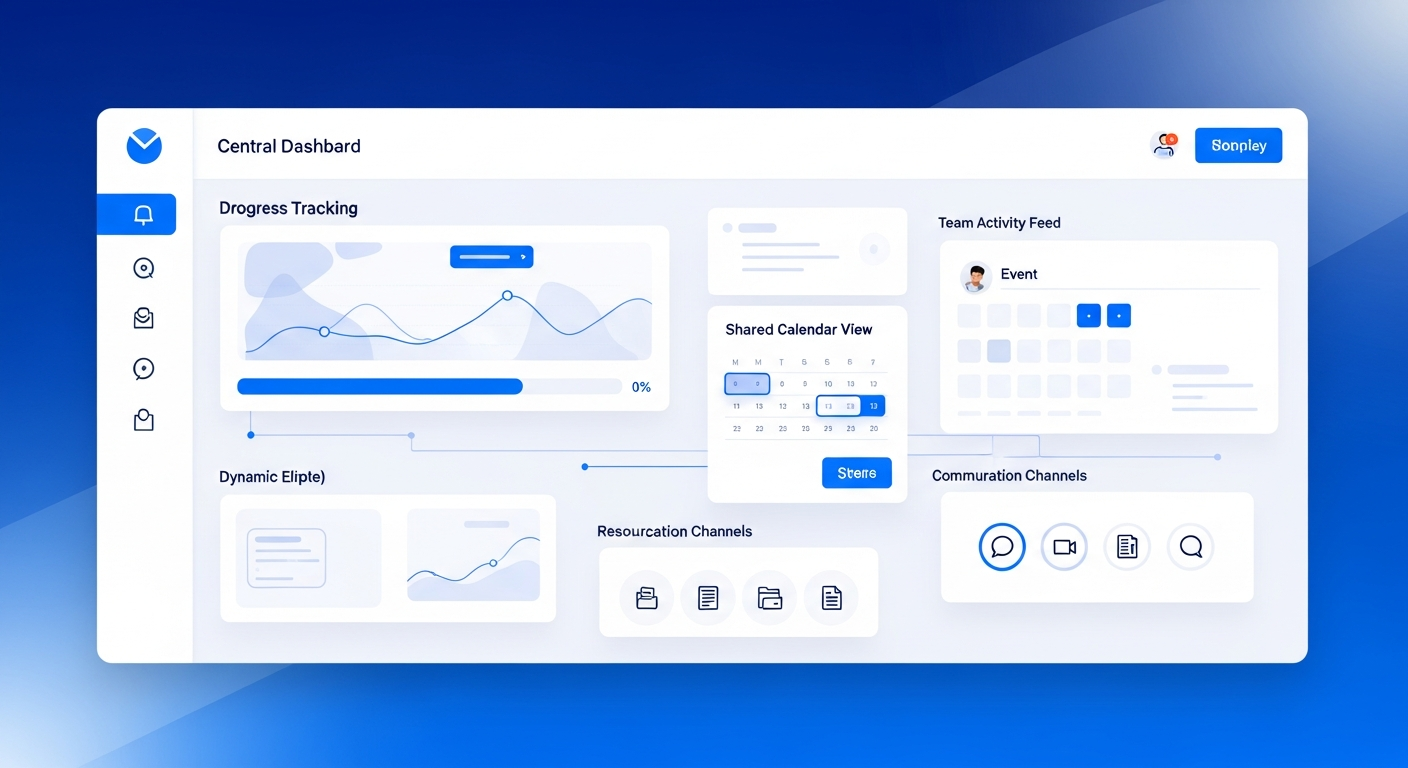
Platforms like Slack have evolved into much more than chat apps; they are now command centers. Through advanced API integrations, a developer can push code, a salesperson can update a CRM, and an HR manager can approve a vacation request—all without ever leaving the primary communication interface.
For business owners, this consolidation reduces costs and simplifies onboarding. Instead of training a new hire on ten different platforms, you train them on the “Core Hub.” The best remote team collaboration tools 2026 are those that play well with others. Interoperability is the new gold standard; if a tool doesn’t have a robust, AI-friendly API, it is likely to become obsolete.
***
FAQ: Common Questions About Remote Tools in 2026
#
Q1: Is VR/AR mandatory for remote teams in 2026?
No, it is not mandatory, but it is becoming a competitive advantage. While basic communication can still happen via screen and keyboard, teams that use spatial computing report higher levels of social cohesion and faster resolution of complex spatial problems (like design or engineering). Most 2026 software is “hybrid-ready,” allowing users to join via headset, tablet, or desktop.
#
Q2: How does AI in these tools impact the privacy of my employees?
This is a major concern in 2026. Leading tools now offer “Privacy-First AI” settings where data is processed locally or in a private instance, ensuring that sensitive employee interactions are not used for global model training. Business owners should look for platforms with “SOC 3” compliance and transparent AI ethics policies.
#
Q3: What is the “Toggle Tax,” and how do 2026 tools solve it?
The “toggle tax” refers to the loss of productivity caused by constantly switching between different applications. In 2026, tools solve this through “Deep Integration” and “Contextual Overlays,” where information from your CRM or Project Manager is visible within your email or chat app, eliminating the need to switch tabs.
#
Q4: Are there specific tools tailored for small businesses vs. enterprises?
Yes. While enterprises often opt for the security and scale of Microsoft 365 or Salesforce, small businesses in 2026 are gravitating toward “all-in-one” challengers like Notion or ClickUp. These tools offer the flexibility of a custom-built system without the need for a massive IT department.
#
Q5: Can these tools help with time zone management in global teams?
Absolutely. 2026 tools feature “Visual Time Zone Mapping” and “Smart Scheduling.” AI assistants can now suggest the “least-painful” meeting time for a global group and automatically record/summarize the session for those who were sleeping, ensuring no one is left out of the loop regardless of their geography.
***
Conclusion: Building Your 2026 Digital Headquarters
Choosing the right remote team collaboration tools 2026 is an exercise in future-proofing your organization. We have moved past the era of simply “making do” with remote work; we are now in the era of “Remote Excellence.” The tools you select today will define your company culture, your operational efficiency, and your bottom line.
For the business owner, the goal is to create a frictionless environment where technology supports, rather than hinders, the human element. By focusing on AI-native platforms, embracing the possibilities of spatial computing, and prioritizing security and integration, you can build a digital headquarters that transcends physical boundaries.
The year 2026 offers a world where your team can be as connected and productive from a home office in Lisbon as they are from a skyscraper in New York. The technology is here; the only question is whether you have the vision to implement it. Invest in tools that don’t just track tasks, but empower people. That is the true secret to success in the decentralized world of 2026.