
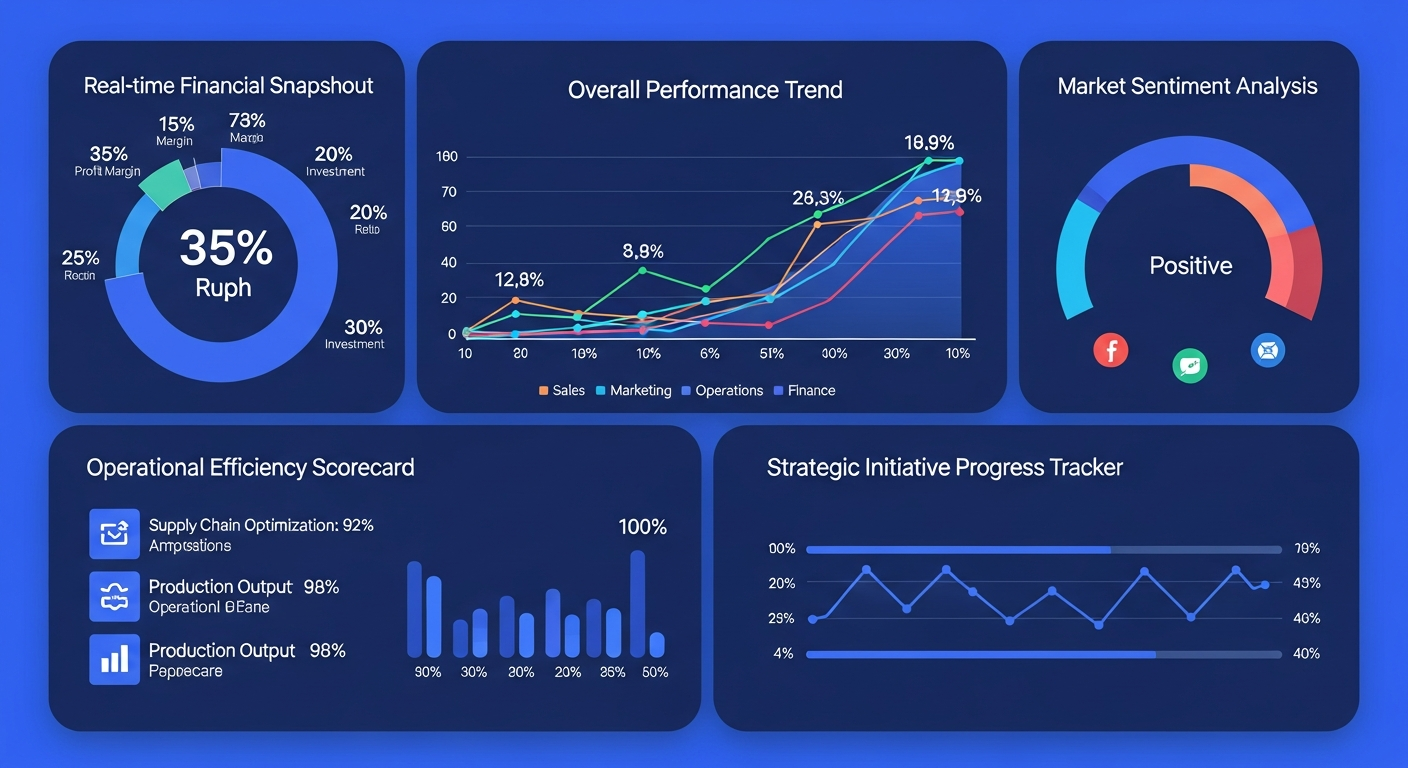
The Future of Efficiency: The Top Business Management Software of 2026
The business landscape of 2026 is no longer defined by simple digital transformation; it is defined by autonomous operations and hyper-personalized intelligence. For business owners and professionals, the challenge has shifted from “going digital” to “staying integrated.” As we navigate this year, the sheer volume of data generated by global commerce requires more than just a spreadsheet or a basic task manager. It requires a unified command center.
Choosing the right business management software in 2026 means looking beyond basic features like invoicing or scheduling. Today’s market-leading tools leverage generative AI, predictive analytics, and seamless API ecosystems to create a “digital nervous system” for your company. Whether you are managing a remote global team or a local boutique, the software you choose acts as the foundation for your scalability. In this guide, we explore the top-tier solutions that are setting the standard for efficiency and growth this year, helping you navigate the complex selection process with confidence.
—
1. The Paradigm Shift: What Defines Business Management in 2026?
By 2026, the definition of “management software” has fundamentally changed. We have moved past the era of fragmented apps—where one tool handled payroll and another handled project tracking—into the era of the “Unified Business OS.” The primary differentiator in 2026 is the presence of **Autonomous Workflows.**
In previous years, software acted as a passive repository for data. You entered information, and the software stored it. Today, the top tools are proactive. They analyze market trends in real-time, predict cash flow shortages before they happen, and even draft responses to client inquiries based on historical data.
Furthermore, the “User Experience” (UX) has evolved into “Agentic Experience.” Business owners are no longer just clicking buttons; they are interacting with AI agents that perform multi-step tasks across different departments. When evaluating software this year, the focus is on how well a tool integrates with your existing stack and how much “cognitive load” it removes from your leadership team. Interoperability is no longer a luxury; it is a baseline requirement for any software hoping to lead the market in 2026.
2. Next-Generation ERPs: The Multi-Functional Powerhouses
Enterprise Resource Planning (ERP) systems remain the backbone of large-scale operations, but in 2026, they have become more agile and accessible for mid-sized businesses.
#
NetSuite (Oracle)
NetSuite continues to dominate the 2026 landscape by refining its “SuiteSuccess” models. Its strength lies in its ability to provide a 360-degree view of a business in a single cloud instance. This year, NetSuite has doubled down on AI-driven supply chain manifestations, allowing businesses to simulate global logistics disruptions and adjust procurement automatically. For professionals who need a “single source of truth,” NetSuite remains the gold standard.
#
SAP S/4HANA
SAP has spent the last few years transitioning its massive user base to a completely cloud-native environment. In 2026, S/4HANA is recognized for its “Sustainability Ledger.” As global regulations around carbon footprints and ethical sourcing tighten, SAP provides automated reporting that tracks the environmental impact of every transaction. It is the go-to choice for global enterprises that must balance complex compliance with rapid growth.
#
Odoo
Odoo has emerged as the “disruptor” of 2026. Its open-source, modular approach allows business owners to pay only for what they use. For a growing startup, Odoo’s ability to start with a simple CRM and expand into manufacturing, e-commerce, and inventory within the same interface is unmatched. Its 2026 updates have focused on a significantly cleaner UI and “no-code” customization options that empower non-technical managers.
3. Advanced Project Management and Workflow Orchestration
Project management in 2026 has moved beyond the Gantt chart. The focus is now on **Workflow Orchestration**—ensuring that tasks move through a pipeline based on priority, resource availability, and external deadlines without manual intervention.
#
Monday.com (Work OS)
Monday.com has transitioned from a colorful task tracker to a robust “Work OS.” In 2026, its standout feature is the “Predictive Milestone” engine. By analyzing past project performance, Monday.com can accurately predict if a project is likely to go over budget or miss a deadline weeks in advance. Its deep integration with communication tools makes it a favorite for hybrid teams who need a visual pulse on company-wide productivity.
#
ClickUp
ClickUp’s “One App to Replace Them All” mantra has reached its peak in 2026. The platform has successfully integrated whiteboarding, document collaboration, and goal tracking into a high-speed interface. This year, ClickUp 4.0 (the 2026 flagship version) introduces “Neural Search,” which allows users to ask natural language questions like, “What were the main objections in the Q3 marketing meeting?” and receive instant, synthesized answers from across all tasks and docs.
#
Asana
Asana remains the leader for organizations focused on “Alignment Science.” Its “Goals” feature is now powered by AI that aligns individual daily tasks with high-level corporate objectives. For executives in 2026, Asana provides a “Command View” that shows exactly how a delay in a creative task affects the company’s annual revenue targets.
4. CRM and Customer Experience (CX) Hubs
In 2026, a CRM (Customer Relationship Management) is no longer a digital Rolodex; it is an engine for **Hyper-Personalization.** Customers expect businesses to know their needs before they express them, and these tools make that possible.
#
Salesforce (Einstein 1 Platform)
Salesforce continues to lead the pack by making AI (Einstein) the core of its ecosystem. In 2026, Salesforce isn’t just for sales teams; it’s for “Customer Success Orchestration.” Their new predictive scoring models analyze millions of data points—from social media sentiment to historical buying patterns—to tell a sales rep exactly when to call a prospect and what specific solution to offer.
#
HubSpot
HubSpot has won over the mid-market in 2026 by emphasizing ease of use and “Contextual Marketing.” Their Smart CRM automatically updates itself by scraping public data and internal communications, meaning sales reps spend zero time on data entry. The 2026 HubSpot Content Hub also allows businesses to generate personalized video content for leads at scale, a feature that has become essential for standing out in a crowded digital marketplace.
#
Zoho CRM
Zoho remains the most cost-effective yet powerful alternative in 2026. Its “Zia” AI assistant has become incredibly sophisticated, capable of performing voice-activated data queries and sentiment analysis on customer calls. Zoho’s strength is its ecosystem; it offers a suite of over 50 apps that integrate natively, making it a favorite for business owners who want a cohesive experience without the “Salesforce tax.”
5. Financial Management and Autonomous Accounting
Finance departments in 2026 have shifted from “closing the books” to “continuous accounting.” The software in this category focuses on real-time visibility and automated compliance.
#
QuickBooks Online (Intuit)
QuickBooks remains the dominant force for small to medium businesses (SMBs). In 2026, its standout feature is “Auto-Tax Sync,” which leverages real-time tax law updates to ensure businesses are always set up for their specific jurisdiction. Its AI-driven cash flow planner can now suggest when to take out a line of credit or when to pull back on spending based on seasonal trends.
#
Xero
Xero has solidified its position as the preferred choice for accountants and modern service-based businesses. Its “Beautiful Business” philosophy is evident in its 2026 interface, which uses advanced data visualization to show business owners their financial health at a glance. Xero’s marketplace of integrated apps is the largest in the world, allowing for niche-specific financial setups.
#
FreshBooks
FreshBooks has evolved to serve the “Modern Professional Services” sector. In 2026, it excels at “Project-Based Accounting,” allowing freelancers and agencies to track every billable second and automatically convert that time into multi-currency invoices. Its 2026 update includes an “AI Retainer Manager” that alerts users when they are nearing their monthly limits with a specific client.
6. HR and Talent Management for the Global Workforce
With the global talent war in full swing in 2026, HR software has pivoted toward **Employee Experience (EX)** and **Global Compliance.**
#
Rippling
Rippling has become the gold standard for businesses that hire globally. In 2026, its ability to manage “Headcount, IT, and Finance” in one place is revolutionary. Rippling can hire an employee in a new country, ship them a laptop, set up their local payroll, and grant them access to 20+ software tools in a single click. It effectively removes the administrative burden of international expansion.
#
BambooHR
BambooHR remains the leader for culture-focused organizations. In 2026, its “Pulse Surveys” and “eNPS” (Employee Net Promoter Score) tools are more advanced, using AI to identify burnout patterns before they lead to turnover. It’s designed for the “Human” side of HR, ensuring that while the business scales, the culture remains intact.
#
Deel
Initially a payroll tool for contractors, by 2026, Deel has expanded into a full-scale HRIS (Human Resources Information System). It is the premier tool for companies that are “Remote-First.” Its 2026 platform includes “Deel Shield,” which uses AI to ensure that every contract complies with local labor laws in over 150 countries, protecting businesses from the legal complexities of a borderless workforce.
—
FAQ: Navigating Business Software in 2026
**1. How do I know if my business is ready for an ERP?**
Most businesses should consider an ERP when they find themselves using more than five disconnected apps to run their daily operations. If your finance team is manually exporting data from your sales tool to create reports, or if inventory levels don’t match your e-commerce storefront in real-time, it is time to move to a unified ERP like NetSuite or Odoo.
**2. Is AI in 2026 software safe for sensitive data?**
Yes, but with caveats. Leading software providers in 2026 utilize “Private AI” models. This means your data is used to train an instance of the AI that is exclusive to your company; your proprietary information is never leaked into the public pool (like the early versions of ChatGPT). Always check for SOC2 Type II and GDPR-2026 compliance.
**3. Can I switch management software without losing my historical data?**
In 2026, data portability is a standard feature. Most top-tier tools offer “Automated Migration Wizards” that can map and import data from competitors. However, a clean data audit is recommended before any migration to ensure you aren’t moving “junk data” into a new, expensive system.
**4. What is the average implementation time for these tools?**
For SaaS tools like ClickUp or HubSpot, you can be up and running in days. For complex ERPs like SAP or NetSuite, implementation usually takes 3 to 6 months. Many companies in 2026 use “Agile Implementation,” where they roll out one module (like CRM) first and then expand to others over time.
**5. How much should I budget for business management software?**
In 2026, most software has moved to a “Value-Based” or “Usage-Based” pricing model. For a mid-sized company, expect to invest 2% to 5% of your annual revenue into your software stack. While it seems high, the ROI is found in the reduction of manual labor and the prevention of costly operational errors.
—
Conclusion: Choosing Your Foundation for 2026 and Beyond
As we move through 2026, the gap between businesses that utilize advanced management software and those that rely on legacy systems is widening into a chasm. The tools highlighted in this guide—from the robust ERP capabilities of NetSuite to the agile project management of Monday.com—are not merely expenses. They are the engines of modern commerce.
The right software for your business is the one that disappears into the background, allowing your team to focus on creative strategy and customer relationships rather than data entry and administrative troubleshooting. When selecting your stack this year, prioritize integration, demand AI that provides actionable insights, and ensure the tool can scale as fast as your ambitions. In 2026, efficiency isn’t just about doing things faster; it’s about having the right system to do the right things automatically. Choose wisely, and your software will be the most valuable employee on your payroll.