
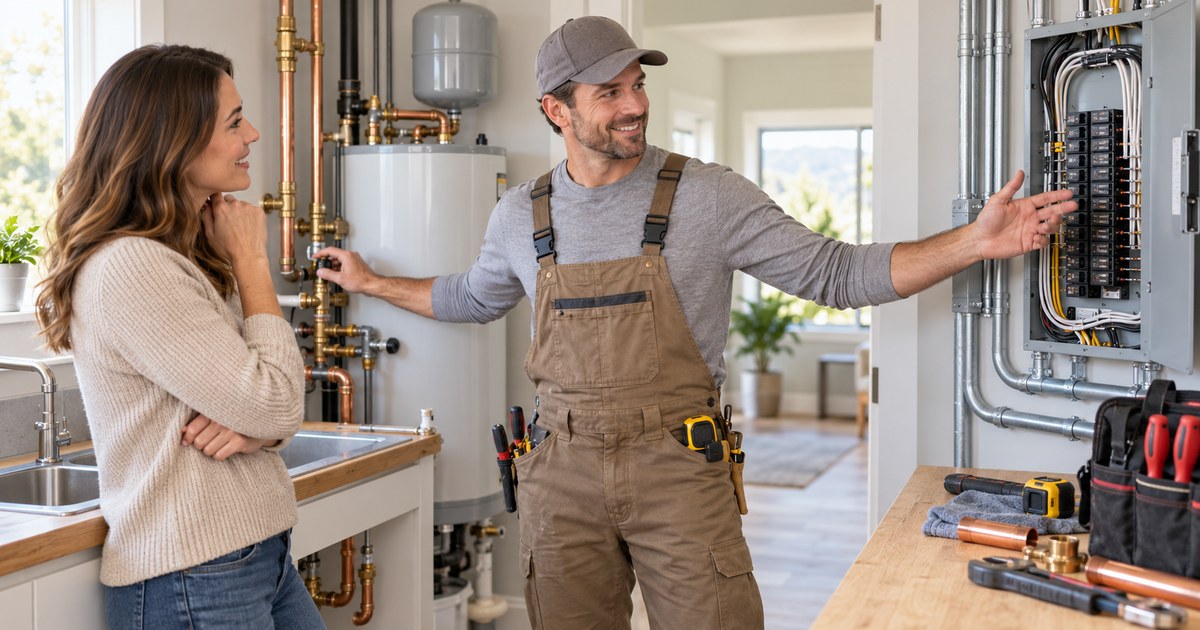
Anyone who has replaced a water heater knows the drill. The plumber pulls the old tank, sets the new one, and then discovers the dedicated circuit feeding it is undersized for the replacement unit. Now there is a second phone call, a second scheduling window, a second trip charge, and a week where nobody has hot water while two companies wait on each other.
That handoff problem is quietly reshaping how homeowners shop for service work. A growing number of people are looking for a single company that holds licenses in both plumbing and electrical rather than keeping two contractors on speed dial.
The jobs that live in both trades
More residential work crosses the line between the two trades than most homeowners realize.
A tankless water heater conversion is plumbing on the supply side and electrical on the control and venting side. A standby generator needs a gas line run and pressure tested, and a transfer switch wired into the panel. A kitchen remodel moves a sink drain and adds circuits for a disposal, a dishwasher and a microwave in the same two weeks. A well system is a pump, a pressure tank and a dedicated circuit with the correct protection. Even a bathroom addition puts a licensed plumber and a licensed electrician in the same small room, working around each other.
Split those jobs across two companies and the homeowner becomes the project manager. They are the one relaying what the electrician said to the plumber, absorbing the schedule slip, and holding the bag when something does not line up.
Where the accountability lands
The scheduling friction is the visible cost. The warranty question is the expensive one.
When a new water heater fails eight months in, was it the tank or the circuit? When a generator will not pick up the load, is it the gas supply or the transfer switch? With two contractors, each has a reasonable case that the problem sits on the other side of the boundary, and the homeowner pays two diagnostic fees to find out which.
A company that did both sides of the work does not get that argument. The warranty covers the whole installation, and there is one number to call. That is the actual value of a two-trade shop, and it is worth more than the trip charge it saves.
What to check before you hire
Dual-license shops are less common than single-trade companies, and the label alone is not proof of competence. A few things are worth verifying.
Ask for the license numbers for both trades and confirm they are current with the state board. A company that does electrical work under a plumbing license, or subcontracts one side to a rotating cast of trucks, is not what a homeowner is buying.
Ask how long the warranty runs on workmanship, not just on the manufacturer's part. Manufacturer coverage on a water heater or a panel is standard. Labor coverage is where companies differ, and a multi-year workmanship warranty tells you something about how confident the company is in its own installs.
Ask whether technicians are background checked and drug screened. These people are in the house, sometimes with only a spouse and small children home. It is a fair question and a reputable company answers it without getting defensive.
Ask about diagnosis and pricing. The better answer is a technician who walks through options at the house and prices them up front, rather than an online estimator that produces a number nobody can honor once they see the actual conditions.
The regional operators doing it
Two-trade companies tend to be regional rather than national, because holding and staffing licenses on both sides is easier at a local scale than across state lines. In south Louisiana, Pipes and Plugs runs plumbing and electrical out of the same shop across the Acadiana region, with named technicians and a single workmanship warranty covering both sides of the work. Similar operators exist in most markets, and they are usually the second-generation family shops rather than the newest entrants.
The practical takeaway
Nobody needs to fire a plumber they trust. But it is worth knowing before the next project whether the company on your list can handle the electrical half of the job, because the odds that a repair stays cleanly inside one trade are lower than they look. Find that out on a calm Tuesday rather than at nine on a Saturday night with water on the floor and a breaker that will not reset.